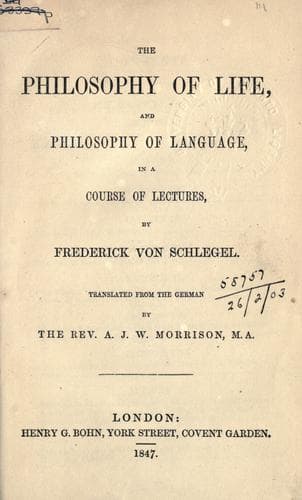
The philosophy of life, and philosophy of language, in a course of lecturesSchlegel, Friedrich von
Philosophy
The philosophy of life, and philosophy of language, in a course of lectures
Schlegel, Friedrich von
Language and languages -- Philosophy; Life; Philosophy
Applied to the alternating states of sleeping and waking in the outward
organic life, this would merely mean that in sleep we always dream, even
at those times when our vision leaves no traces on our memory. The great
majority of dreams, even those which in the moment of awakening we still
remember, are absolutely nothing but the conjoint impression of the
bodily tone and the ever-varying temperament of life and health, and of
the disorderly repetition of such ideas as previously to sleeping had
principally engaged the attention. Now, since every opposite comes near
to its correlative in one or more points of contact, which, as they
establish, also serve to maintain the relationship between the two, so
the state of the soul in dreaming will serve strikingly to illustrate
its waking action. Of the great multitude of dreams, which are for the
most part confused and unmeaning, some occasionally stand out from the
rest extremely clear and well-connected, in which the feelings
oftentimes discover a profound significance, or which, at least, as
significant images, interest the fancy. And just in the same manner in
the state of waking there passes before the soul no inconsiderable
number of obscure and vague conceptions, which are not much if at all
clearer or more methodically disposed than the train of images which in
a dream succeed one another without the least intrinsic order or
connection. Still we should greatly err were we to assume, that like the
latter they leave no trace behind them on the soul. On the contrary, in
these undeveloped beginnings of thought there often lies the germ of
very definite ideas, and especially of the various peculiarities of
mental character, as also of the impulses and determination which, at
first slowly and spontaneously formed, eventuate in some definite
susceptibility or direction of the will. Now, as the external life of
man alternates between the waking activity and the state of repose in
sleep, so, too, the thinking soul is divided between the abstracting and
classifying Reason and the inventive Fancy.[15] These two are, as it
were, the halves, so to speak, or the two poles of the thinking soul,
of which the one may be regarded as the positive, the other as the
negative. In respect to the inner fruitful cogitation itself--to the
origination and production of thoughts--the imagination, as the
reproductive faculty, is the positive pole. As for the fancy, properly
so called--the poetic _fancy_, or that which plays an important part in
the inclinations and passions--it is only a particular species and
operation of this faculty, which in its general form also manifests
itself in many other directions and spheres of human thought and action.
To it belongs, for instance, that talent of extensive combination which
distinguishes all the great discoverers in mathematics. Opposite to this
productive faculty of thought, the negative pole is formed by the
classifying faculty of reason, which further elaborates, closely
Public-domain text, read in full here on John Shaqi.
Reviews
Reviews
No reviews yet
Be the first to share your thoughts on this work.
Join the Discussion
Join the discussion
Sign in to leave a comment or review.
Sign InorCreate an account