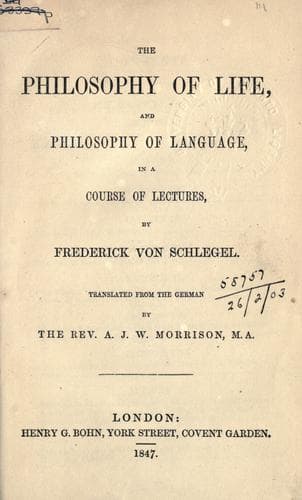
The philosophy of life, and philosophy of language, in a course of lecturesSchlegel, Friedrich von
Philosophy
The philosophy of life, and philosophy of language, in a course of lectures
Schlegel, Friedrich von
Language and languages -- Philosophy; Life; Philosophy
It can easily be shown that education as well as art is essentially
symbolical. Such, indeed, must be the character of the education,
whether public or private, of the whole rising generation, unless it is
to degenerate into an ordinary mechanical system. And it is even in this
quality principally that we are disposed to place the distinction
between an unspiritual education, which, even though in the sternness of
its morality it may defy censure, yet eventually proves barren and
mortal, and one more solid and more conformable to human nature, which,
less pretending in the outset, is even the more lasting in its effects.
The ready susceptibility of the youthful mind for every thing symbolical
that lies within its reach, and its vivid perception of its meaning,
might be clearly enough shown by instancing some of the ordinary
amusements of boyhood and youth. How commonly, in these years, are the
various occupations, pursuits, and circumstances of real and, to them,
still future life, childishly, perhaps, but still ingeniously imitated,
or, rather, anticipated! And how lasting an influence does this
frequently make on their little society! What various but lasting traces
does it often leave on their minds, more perhaps than many hours of
study, especially if in the latter the usual system of overloading the
young mind defeats its own end. Play, indeed, must not become the mere
pastime of idleness, for it is only by its alternation with labor and
the sternness of discipline that it continues to be a recreation and a
pleasure.
And, indeed, the earnestness, the labor, and the sterner part in this
whole business and matter of education, as mixed and composed of two
opposite elements, of the serious and the sportive, is highly capable of
receiving so spiritual a reference and vital a significance. And if all
education be nothing else than a preparation for the future, and the
state of this preparation, then it must be self-evident that too many or
enough of such vivid references and spiritual allusions to a future
life, either generally or to any particular phase of it that may chiefly
be had in view, can not be introduced into education and its serious and
sportive elements and pursuits. For it is only by this method that the
susceptibilities of youth and the youthful fancy can be vividly excited
and thoroughly impressed with the fundamental design and significance of
the whole of life--a result which no mere dry definition of the future
state, or generally of any “destination of man” on the dusty road of
logic, will ever attain to.
Public-domain text, read in full here on John Shaqi.
Reviews
Reviews
No reviews yet
Be the first to share your thoughts on this work.
Elsewhere in the archive
Join the Discussion
Join the discussion
Sign in to leave a comment or review.
Sign InorCreate an account