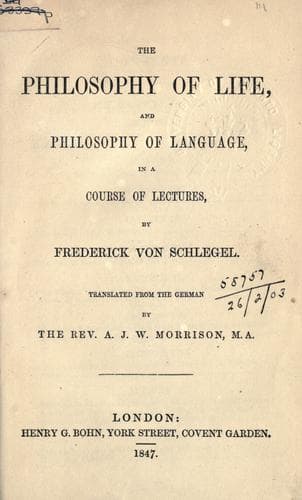
The philosophy of life, and philosophy of language, in a course of lecturesSchlegel, Friedrich von
Philosophy
The philosophy of life, and philosophy of language, in a course of lectures
Schlegel, Friedrich von
Language and languages -- Philosophy; Life; Philosophy
It is nowise singular if this symbolical property and disposition of
human nature announces itself as distinctly in the earliest development
and in the most perfect of the productions of artistic genius, whether
we take into consideration the whole existing state of mankind, or his
original and essential constitution relatively to the world and to God.
We have already remarked, on more than one occasion, that man, as soon
as he was deprived of those higher faculties which he had abused to his
ruin, fell thereby more entirely than would seem originally to have been
the case, under the dominion of figurative fancy, and that,
consequently, his whole nature and consciousness became greatly changed
from what it was at the beginning. If man did at the very first possess
the faculty and the power to communicate his thoughts to others inwardly
by a mere operation of his will, and without having recourse to the
external medium of words, he no longer enjoys this privilege; and if any
wonderful phenomena in any way resembling thereto be now found, they
only form so many remarkable exceptions, instead of making the rule of
human life and consciousness as they now are. As at present
constituted, man feels that his state is pre-eminently symbolical: he
sees in symbolism a necessary requirement for his earthly pursuits--a
substitute for those immediate powers of cogitation which he has lost.
And all this is true, independently of any use he may freely choose to
make of symbols for the higher purposes of spiritual life.
Man, at the beginning, was placed on this earth as its first-born son,
in the midst of the telluric universe, or, in other words, in the center
of a planetary world akin to and similar to his own. Now, whatever may
be the case, or whatever it may be allowable to think of any other of
the starry spheres--though in the invisible world of spirits all perhaps
is more immediately full of and instinct with essence, and is not veiled
in material emblems, this is not the case with this earth. Terrestial
nature, in all its organic productions and warring elements of life, is
throughout symbolical. Man, therefore, viewed from this position of his
earthly habitation, is surrounded by a symbolical world of sensuous
emblems. And if we can, or, rather, if we will, believe the grand
intimation with which revelation opens, the first and highest
destination of man is even symbolical--to be the Divine image.
Public-domain text, read in full here on John Shaqi.
Reviews
Reviews
No reviews yet
Be the first to share your thoughts on this work.
Elsewhere in the archive
Join the Discussion
Join the discussion
Sign in to leave a comment or review.
Sign InorCreate an account