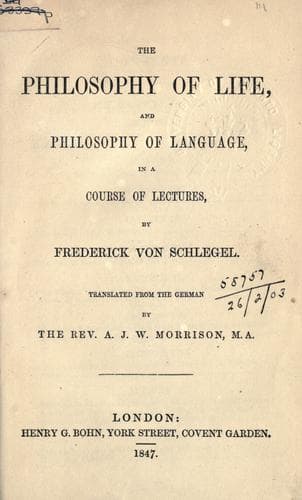
The philosophy of life, and philosophy of language, in a course of lecturesSchlegel, Friedrich von
Philosophy
The philosophy of life, and philosophy of language, in a course of lectures
Schlegel, Friedrich von
Language and languages -- Philosophy; Life; Philosophy
Most natural, therefore, is it (that is to say, most consistent with the
nature of the thing, which however in itself is supernatural,
incomprehensible, and surpasses all conception), that the highest symbol
of the faith, that which forms the principle of communion and the living
center of unity of all Christendom, should have such a character as to
be at once a symbol and also the veritable reality of the thing itself.
For inasmuch as on the altar of this religion of divine love, since the
one oblation has long ago been perfected, no other fire shall again be
kindled but the flame of prayer and of a will directed to and in unison
with God; therefore, the act by means of which that communion of souls
which constitutes the essence of all religion, is maintained and carried
on, consists simply in this, that the essential substance of the divine
power and of God’s love to man is given and received as the wonderful
seal of union with Him.[52]
As to the altar itself, how rich or how simple its ornaments ought to
be, is a question which I have already remarked, does not easily admit
of any general solution. If, however, we should attempt to think of
Christianity without an altar, or desire and attempt to establish such a
scheme--what indeed among the vast variety of human conceits and
religious theories has only occurred to a very limited number, and never
has and never will exercise any lasting and decided influence--a
Christianity thus divested of symbols and mysteries would be degraded
into a mere philosophical view and opinion--or at the very best, a
school of the kind--any thing, in short, rather than religion. Even the
study of the Bible, if in spite of so sad a state of things it should
still survive, would sink into a mere matter of erudition, on a level
with any other favorite pursuit of antiquarian lore and research. And
if, on the other hand, rising perhaps somewhat higher than a mere
philosophical opinion or the favorite pursuits of erudition, a religious
community, having no altar at all, should pretend to rest entirely on
prayer and spiritual teaching or preaching, such a scheme must
presuppose an immediate inspiration, communicable to all and continuous
throughout time. But such an hypothesis invariably proves the easy and
natural transition to the most frightful fanaticism, of whose pernicious
and evil effects those only who are acquainted with the domestic history
of Mohammedism, among whose modern and ancient sects this idea is
rampant, can form a clear and adequate conception.
Public-domain text, read in full here on John Shaqi.
Reviews
Reviews
No reviews yet
Be the first to share your thoughts on this work.
Elsewhere in the archive
Join the Discussion
Join the discussion
Sign in to leave a comment or review.
Sign InorCreate an account