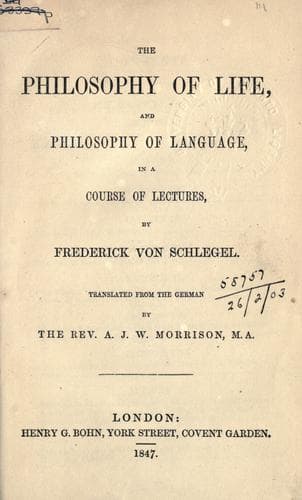
The philosophy of life, and philosophy of language, in a course of lecturesSchlegel, Friedrich von
Philosophy
The philosophy of life, and philosophy of language, in a course of lectures
Schlegel, Friedrich von
Language and languages -- Philosophy; Life; Philosophy
But the symbolical dress that religion every where assumes constitutes
but one half of its external form. The other consists in the vital and
intrinsic union of all the members and professors of the common faith.
Religion can not by any means be isolated and solitary. It is impossible
to think of it as existing only for the individual. In a word, there is
no such thing as religion in a proper sense without a community. Two or
three must at least be united in a common faith, that its power and
efficacy may be visible among them. And this association is one vital
throughout--an inmost bond binding souls together by a spiritual
attraction, and, as it were, enchainment of the several members.
As the electrical shock traverses instantaneously the entire chain of
the connected links, and the spark which enters at one extremity flashes
the next moment at the other--as a single loadstone will by contact
convert any number of needles into magnets, and elevate them into a new
and higher relation to the whole globe--so is it also in religion. A
living communication from the first origin runs through the whole
community. As in the voltaic pile, composed of alternate layers of two
different metals, one chemical element of the telluric energy or of the
vital principle of the air or atmosphere is emitted or set free on one
side and the other on the opposite; so is it here also in the spiritual
chain of faith and in its living reciprocal action of the different
members of this soul-chain--between those who are active ministers and
conductors, or instruments by which it works, and the others, who in a
somewhat passive relation only imbibe the invisible life. By the one the
divine blessing of sanctification and holiness is set in action and
brought to light--developed and confirmed; while by the others grace is
received as the effectual power and gift of salvation.
One remark, however, seems particularly called for in this place. It
appears, from what has been already said, that even revelation and the
true religion itself invariably puts on and is invested with that
symbolical garb which is so consonant and agreeable to the state and
nature of humanity. This being the case, it becomes extremely difficult
to form a general standard by which we may unfalteringly determine what
symbols are not essential, as only serving for the external garb of
religion and an intelligible vehicle of its communications. For this, it
is evident, must be governed by the diversity of individual wants and
peculiarities, and must consequently assume a variable and personal
character. If, however, a symbol proceeds immediately from God, then it
must necessarily be essential. It is not only a type, but an actual
substance. To suppose otherwise would be even almost parallel to
presuming to regard the eternal Logos, who is the source of light and
life, of all knowledge and of all being, as a word merely, without
innate energy and substance.
Public-domain text, read in full here on John Shaqi.
Reviews
Reviews
No reviews yet
Be the first to share your thoughts on this work.
Elsewhere in the archive
Join the Discussion
Join the discussion
Sign in to leave a comment or review.
Sign InorCreate an account