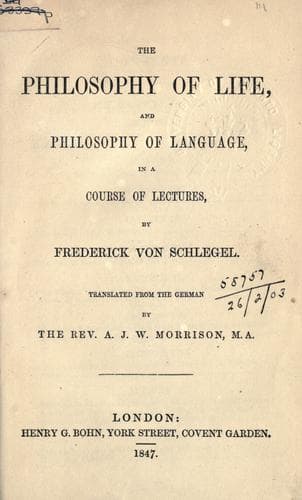
The philosophy of life, and philosophy of language, in a course of lecturesSchlegel, Friedrich von
Philosophy
The philosophy of life, and philosophy of language, in a course of lectures
Schlegel, Friedrich von
Language and languages -- Philosophy; Life; Philosophy
In human life and society there are three species of power, which
possess a symbolical significance and a sacred character as resting on a
divine foundation. And these are parental authority, the spiritual or
priestly power, and the kingly or whatever may be the supreme authority
in the state. The affectionate care and anxiety of an earthly parent
possesses but a faint analogy to the goodness and providence of the
omniscient and eternal Father of all, and is scarcely more than a type
of it. Moreover, the parental authority and a father’s rights over his
children, founded on his relation as the loving and affectionate author
of their being, admits not of being set forth and comprised in any exact
and positive formularies. And even if the social community occasionally
steps in to determine by legislation the limits, and in certain points
gives its sanction to the domestic rights and authority of a father, as
founded on love and feeling, this is only done, nevertheless, with a
view to guard against and to remedy the possible abuse of so natural a
right and relation. When, however, as was the principle of the old Roman
law, power over the life and death of his offspring is conceded to the
father, we feel at once that this is an undue extension of the paternal
authority, and that the provinces of the three different powers are not
kept duly distinct and separate. A parent who should avail himself of
such a privilege would but prove himself devoid of the ordinary
feelings of nature. On the other hand, by a natural sentiment, common to
the savage and barbarian, as well as to the most refined and civilized
nations, respect for and reverence of parents is held to be something
more than an ordinary and conventional duty and obligation. It is
universally regarded in the light of a duty in every sense sacred and
holy. And the divine moral law of the Old Testament completely agrees
with the universal feeling of man’s nature in this ascription to it of
holiness. But, on the other hand, the rights of the Christian limit the
parent’s authority on the side of the spiritual domain, wherever it
would trench upon the freedom of belief and liberty of conscience.
Special circumstances, again, such as the dotage of old age, mental
weakness, faults of character, or offenses against society, may, in
certain cases, tend greatly to limit and control, or otherwise modify,
the parental dignity and authority. But still, in the very worst case,
the most respectful behavior and the tenderest delicacy, on all points
connected with this relationship, remains forever an immutable law of
duty to the child, which, as it is deeply founded in the moral sense of
man, makes itself heard throughout the whole habitable world. The mutual
tie of parental love and filial duty has, it is plain, its foundations
deep in nature itself, and out of it proceeds the sanctity of the very
notion of domestic life, and of all its relations, as well as of the
Public-domain text, read in full here on John Shaqi.
Reviews
Reviews
No reviews yet
Be the first to share your thoughts on this work.
Elsewhere in the archive
Join the Discussion
Join the discussion
Sign in to leave a comment or review.
Sign InorCreate an account