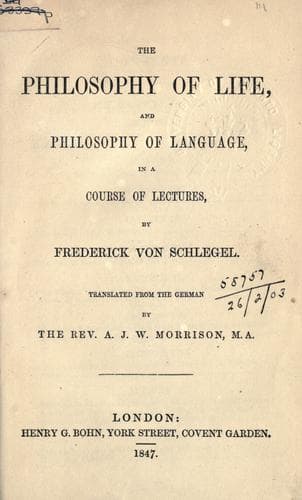
The philosophy of life, and philosophy of language, in a course of lecturesSchlegel, Friedrich von
Philosophy
The philosophy of life, and philosophy of language, in a course of lectures
Schlegel, Friedrich von
Language and languages -- Philosophy; Life; Philosophy
peculiar authority of a father and a parent.
As for the spiritual and priestly power: wherever religion recognizes
the priest in his true character--_i.e._, not simply as the preacher and
promulgator, but also as the living channel for dispensing and
communicating the divine grace, he is, in so far as his office is
concerned, and in the discharge of his sacerdotal functions, a
vicegerent of God--not so much, perhaps, of the everlasting Father, the
Creator and Lawgiver of nature, as of the Son who came down into the
world to ransom and redeem the human race. The priestly or spiritual
power, therefore, has a divine foundation on which it ultimately rests.
But inasmuch as that bond of communion which unites our souls with God
must be sought and attained by faith and in the spirit of faith, so this
authority, however holy in itself, is, nevertheless, by its very nature,
confined to the province of spirituals.
The judicial function, also, where it is recognized as dogmatic, is at
least subordinate to that other character whose office it is to carry
out the work of redemption, to dispense the divine grace, and to bless.
For an arbitrary judicial power, where internal caprice is the rule of
judgment, and where the execution of its decrees depends on the
individual, does not in strict truth deserve this appellation. With as
much reason might the anointed head of the state claim, by virtue of
this consecrating and anointing, to exercise the functions of the
spiritual office.
Further, we may observe, all these sacred offices possess a certain
analogy and affinity one with the other. This fact, however, does not in
any way militate against the essential and necessary duty of preserving
a precise and accurate separation of their several functions. The
privacy of home, the family circle, and the relations of domestic life,
are by the laws of most nations regarded as a sanctuary which the
external power of the state ought not lightly and without grave
necessity to violate or profane. On the other hand, in ordinary language
paternal titles are ascribed to the other two powers. But as regards
spiritual personages, this is a mere mark of respect, while, as applied
to the head of the state, it serves to indicate a special character of
goodness and clemency in the government. It is not by any means
applicable generally to the functions of government as marking its
specific nature and essence. For it may not be, nay, perhaps, we should
rather say it can not in all cases be simply and purely paternal.
Public-domain text, read in full here on John Shaqi.
Reviews
Reviews
No reviews yet
Be the first to share your thoughts on this work.
Elsewhere in the archive
Join the Discussion
Join the discussion
Sign in to leave a comment or review.
Sign InorCreate an account