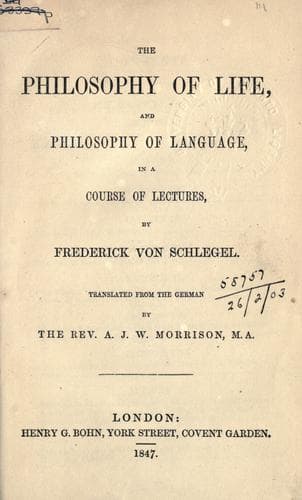
The philosophy of life, and philosophy of language, in a course of lecturesSchlegel, Friedrich von
Philosophy
The philosophy of life, and philosophy of language, in a course of lectures
Schlegel, Friedrich von
Language and languages -- Philosophy; Life; Philosophy
With respect to legislation, however, and the legislative authority, an
important co-ordinate power may, according to the existing constitution
of a particular state, be vested in the other correlative members of the
body politic. The preliminary deliberation, the first sketch or the
initiation of a law, may not, perhaps, proceed in every case from the
supreme head of the community. In other states, again, the law must
emanate from the free choice and individual will of the monarch, or at
least the introduction of it, since he can not of himself alone make and
carry out the whole. This is a point, consequently, on which it is
extremely difficult to draw the boundary line, which must in no case be
transgressed or deviated from--in so far, that is, and so long as there
is no question about any thing more than a simple co-operation or
co-ordinate deliberation upon the proposed laws. But still in every case
the final sanction, by which a law becomes properly the law, or by which
it is annulled or repealed, must be reserved to the royal prerogative,
otherwise the monarch ceases at once to be supreme.
Even the prerogative of proclaiming war and of concluding peace is, if
perhaps we may be allowed so to say, a judicial function on a large
scale, and applied to the external relations of states. It is, in short,
nothing less than a judicial act. And in this light it will appear to
every one who does not regard it as a mere act of arbitrary caprice.
This, however, it never ought to be. For it is, as it were, a verdict
on the existing relations of right and wrong between two neighboring
states. But in as much as both parties, in point of right and law, are
in so far equal, that they refuse to recognize in common any higher
judge, an absolute state of violence necessarily ensues, a struggle of
power follows, until at last, in the change of circumstances, the
relations of justice are restored by mutual consent. The party that
first proclaims war becomes, in this process of trial by battle, the
judge of its own cause. And if by the fearful issue of the combat it is
taught to see its own injustice, then must it either make due
concessions, or, at very best, by calling in the mediation of a third
and neutral state, it must constitute it the judge by whose decision it
is ready and willing to abide.
Public-domain text, read in full here on John Shaqi.
Reviews
Reviews
No reviews yet
Be the first to share your thoughts on this work.
Elsewhere in the archive
Join the Discussion
Join the discussion
Sign in to leave a comment or review.
Sign InorCreate an account