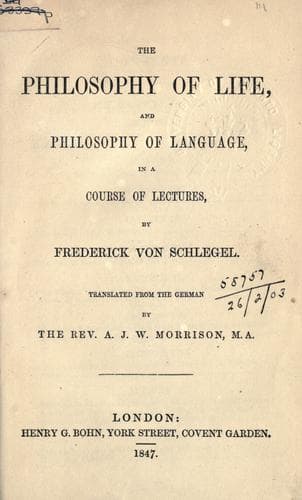
The philosophy of life, and philosophy of language, in a course of lecturesSchlegel, Friedrich von
Philosophy
The philosophy of life, and philosophy of language, in a course of lectures
Schlegel, Friedrich von
Language and languages -- Philosophy; Life; Philosophy
The Asiatic custom of deifying their earthly rulers by addressing them
as King of Kings, Lord or Spanner [_Umspanner_] of Creation, the
Effulgence of the Deity, and the like, have ever been and very naturally
most repugnant to the moral sense of Christian Europe. The Christian
notion and axiom, that all power is of God, is founded on a very
definite idea and well-considered principle. And this principle is
nothing less than this, that the supreme head of the state has to
dispense the divine justice. And while this constitutes the peculiar
dignity of his office, he is, in the exercise of this his highest
function and authority, responsible to God alone. If, however, we should
any where meet, either in the present times or the history of the past,
with a state in which, by the principle of its constitutions, the
nominal possessor of supreme authority and the executive is responsible
to another body, then is the latter in fact the sovereign power, and not
the former, which really is subordinate to the other. The Spartan
constitution will serve to illustrate my meaning. Here, to judge by that
strict definition of the sovereign authority and its peculiar character
and distinctive criteria, it evidently lay in the Ephori rather than in
the possessors of supreme executive power, who were called kings, and
whose office was hereditary. The very fact that two kings reigned
conjointly is of itself subversive of the very notion of sovereign
power. But still more fatally was this undermined by their
responsibility in certain cases to the censorship of the other Spartan
magistracy. To the other ancient republics, whose constitution was based
naturally enough on a very artificial division of powers, and the
maintenance of a certain antagonism and accurate balance between them,
our notion of a supreme and sovereign political authority is scarcely
applicable. It is found far more fully expressed in a special character
of inviolable sanctity and dignity attaching to certain judicial
functions and magistracies, such as that of the Areopagus in Athens and
of the censorship at Rome in the days of the Republic, than to the
transitory tenure of the executive power, over which those judicial
authorities possessed and exercised in certain cases a control.
The proper and _de facto_, or personal division of power, is essentially
a republican principle. In notion, however, or in idea, it is perfectly
legitimate to make a distinction between the several functions and
elements of the whole sovereign authority. Now, in such a case, the
judicial power--the supreme judicial power we would emphatically say--is
pre-eminently the characteristic sign and specific distinction of
sovereignty, from which all its other prerogatives and properties are
originally derived or flow from it as its necessary and natural
consequences. The noble prerogative of pardon and mercy, for instance,
is, as it were, the natural attribute of the supreme judicial power.
Public-domain text, read in full here on John Shaqi.
Reviews
Reviews
No reviews yet
Be the first to share your thoughts on this work.
Elsewhere in the archive
Join the Discussion
Join the discussion
Sign in to leave a comment or review.
Sign InorCreate an account