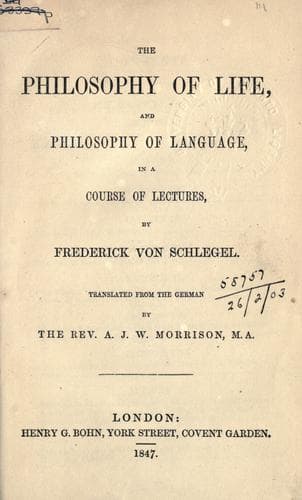
The philosophy of life, and philosophy of language, in a course of lecturesSchlegel, Friedrich von
Philosophy
The philosophy of life, and philosophy of language, in a course of lectures
Schlegel, Friedrich von
Language and languages -- Philosophy; Life; Philosophy
To this ancient idea of a Christian empire we shall again have occasion
to revert in the further examination of the idea of a political state
and its Christian community. We shall meet with it once more in that
section of our inquiry which will be occupied with the ruling principle
of right and polity in a system of states as a body, and also in the
mutual relations of its several members. In this section we shall also
show that this principle must be either absolute, that is, one where one
or more of the several members of the union exercises a superior and
preponderating influence, or one artificially constituted and dynamical,
_i.e._, a system of the so-called balance of power. And here will
naturally arise the question whether, for such a confederacy of moral
and civilized societies and nations, a less imperfect and higher, but
common principle of Christian justice might not be found and
established? For any system of mutual confederation, whether absolute or
founded on the artificial relations of the strength of its respective
members, is in any case defective and imperfect, whatever may be the
ground of union, whether founded on the internal constitution of the
states, or derived from the physical consideration of their geographical
position and neighborhood.
According, then, to that divine principle and Christian foundation of
the state which I have attempted to derive from the symbolical
signification of life and the symbolical destiny of man in his relation
to God, the highest authority of the state--the king, or generally the
monarch, as well as the spiritual functionary, or the priest--are the
vicegerents of a highest and divine power, whom they represent on earth.
The only difference between them is, that the latter has chiefly to
represent and to set forth God as teaching men, but at the same time as
warning and commanding them in this revelation of His will, and as
promising and as livingly dispensing to them His grace, while the former
is the representative of the Omnipotent Lawgiver and Judge, who governs
the world with justice, and will by no means clear the guilty.
According, therefore, to the true Christian notion of these two powers,
both of them--the civil no less than the spiritual--possess a
representative character, which, however, deviates very widely from the
ordinary notion of the representation and a representative constitution,
or, rather, forms a decided contrast to them.
Public-domain text, read in full here on John Shaqi.
Reviews
Reviews
No reviews yet
Be the first to share your thoughts on this work.
Elsewhere in the archive
Join the Discussion
Join the discussion
Sign in to leave a comment or review.
Sign InorCreate an account