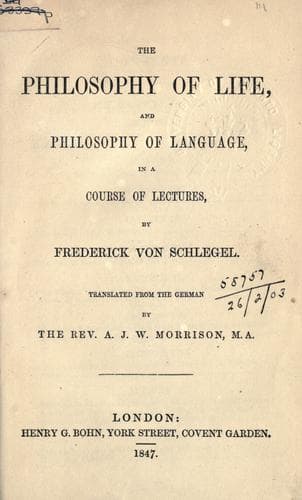
The philosophy of life, and philosophy of language, in a course of lecturesSchlegel, Friedrich von
Philosophy
The philosophy of life, and philosophy of language, in a course of lectures
Schlegel, Friedrich von
Language and languages -- Philosophy; Life; Philosophy
And what contrast can, in fact, be more decided than that which such a
representative power and dignity as belongs to the ministering of the
divine grace to the soul and spirit, or the dispensing of divine justice
to the whole earthly life, forms with that thing of horrible memory,[53]
which has been called a representation of the people, or the systems
which have been similarly designated? But even if it could be
satisfactorily proved that a people, like the invisible essence of the
Deity, could be represented, it is open to very grave doubt whether this
is really possible in the method usually adopted. According to the
principle of this kind of popular representation, where the whole adult
population are entitled individually to vote, the election becomes, as
it were, a lottery, and even the political winners thus determined, or
the ballotted members, become so many influential units in one branch of
the legislative body and for a limited period. In respect, however, to
the principles and sentiments, the predominant character and spirit of a
people, those who are thus chosen are the representatives not so much of
the whole nation as of the reigning passion of the moment, or the spirit
of the times in its restless agitation. For when thus resolved into its
constituent atoms and numbered off in succession, a nation is reduced to
an elementary mass. But like all that is thus elementary, when thus
decomposed, and fermenting in its process of dissolution, it assumes a
destructive tendency and turn. At least it ceases to form an organic
whole, an individual. It is only when a state or a nation historically
lives on, further develops and vitally maintains itself in its organic
members, _i.e._, in its several estates or essential corporations, that
it can be said to form a living whole, and to be, as it were, one great
individual.
Public-domain text, read in full here on John Shaqi.
Reviews
Reviews
No reviews yet
Be the first to share your thoughts on this work.
Elsewhere in the archive
Join the Discussion
Join the discussion
Sign in to leave a comment or review.
Sign InorCreate an account