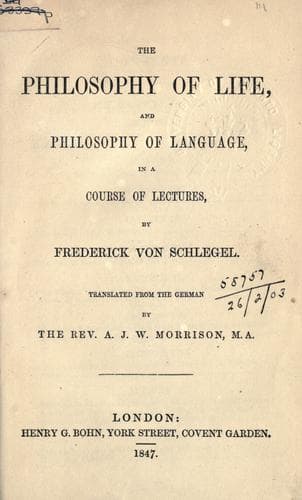
The philosophy of life, and philosophy of language, in a course of lecturesSchlegel, Friedrich von
Philosophy
The philosophy of life, and philosophy of language, in a course of lectures
Schlegel, Friedrich von
Language and languages -- Philosophy; Life; Philosophy
of seeing and hearing there is likewise a certain but imperceptible
contact of the nerves of the eye and ear with the waves of light and the
undulations of the air; but still this contact is of a different kind
from the former, and of another and indeed of a higher nature, producing
the relations of tone, color, and shape. Now, in this classification,
the eye is the mind or spirit’s sense for beauty of form and grace of
motion. It is so in truth, not merely in those who are endowed with a
taste for the arts or the artistic eye, but far more universally, being
diffused in a greater or less degree through the whole human family.
Special gifts of it, or, rather, higher though varying endowments, are
to be found in some highly-favored individuals; and in the same way the
ear for music is not imparted to all who possess the general organ of
hearing, which we very properly term the soul’s sense. The external
senses man shares, indeed, in common with the brutes, in some of whom
they are found of an exquisite and highly-developed susceptibility. But
these higher endowments of eye and ear, and above all the natural
artistic feeling for beauty of form, and the musical talent, are the
prerogatives of man, conferred upon him by his peculiar faculty of
fancy. On this account they, like that faculty, are distributed
unequally among men, though they are not on that account less real and
undeniable.
The brutes, I said, do not possess them. No doubt there is a certain
melodious rhythm perceptible in the songs of birds. Some, also, of the
more eminently docile and sagacious of terrestial animals do indeed
evince peculiar signs of pleasure in the music of man. Still I would
call this but so many single, unconnected echoes or reverberations of
fancy, since every thing like free choice, further development, or
intrinsic coherence, is wanting to them--all is broken, abrupt, and
incapable of being formed into a whole. In the same manner the artistic
instinct and skill of some animals exhibits, no doubt, a certain
likeness in its operations to the rational works of man, but still it
ever remains a resemblance at best, and is forever divided from reason
by a wide and impassable gulf. It is, as it were, the indistinct trace
of a weather-worn and nearly obliterated inscription--the dying notes of
some far-off music. And hence the agreeable, but, at the same time,
melancholy, impression which such things make upon our feelings. A
something human seems to be stirring in them. They appear to revive a
faint but nearly-forgotten allusion to an originally close and intrinsic
relation between animated nature in its highest developments and man as
its former master and as the divinely-appointed lord of the whole
earthly creation. But if the influence and the operation of the fancy on
the external senses be thus indistinct and difficult to be traced, it is
far more apparent, as also far greater and more decided, on the
Public-domain text, read in full here on John Shaqi.
Reviews
Reviews
No reviews yet
Be the first to share your thoughts on this work.
Join the Discussion
Join the discussion
Sign in to leave a comment or review.
Sign InorCreate an account