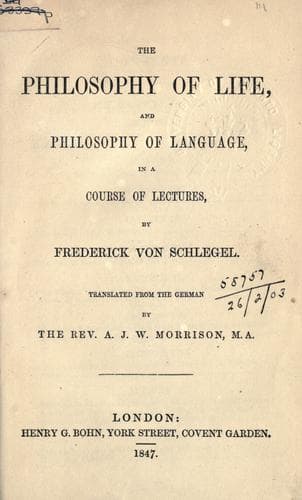
The philosophy of life, and philosophy of language, in a course of lecturesSchlegel, Friedrich von
Philosophy
The philosophy of life, and philosophy of language, in a course of lectures
Schlegel, Friedrich von
Language and languages -- Philosophy; Life; Philosophy
As for those other elective representatives already mentioned, it is
only when they belong to a particular estate and corporation, and
represent it, that they can promote the permanent interests of this
organically constituted whole. For it is out of such organic members
that the national existence gains its true, _i.e._, its historical
development. But this is impossible whenever they are chosen by the
individual votes of the entire population. Such a splitting of the whole
political body, as it were, into its constituent atoms, is either in
itself an elementary decomposition or must eventually lead to it. Even a
republican constitution, if it be well and wisely ordered, will be based
principally on corporations or organic division of estates, rather than
on any principle of numerical majority and equality, which, taken as a
general element, invariably proves, as history testifies, sooner or
later, a positive source of anarchy.
Not only would it be an exaggeration, but even a gross error, were we to
regard the republican polity as excluded from the Christian principle,
that all sovereignty is of God, or as irreconcilable with it and even as
directly contradicting its spirit. On the contrary, the duty of
obedience and the actual dependence on the existing and _de facto_ head
of the state, is not less binding on all who, through the accident of
birth or their own free choice and voluntary obligation, belong to such
a community, than on the subjects of an hereditary monarchy. The utmost
that can be safely asserted is, that the Christian state principally
inclines to the latter form of polity, without, however, formally
rejecting, or unconditionally excluding the former. Historical
experience has shown this, and the whole of modern history will furnish
abundant testimony to its truth. When the responsibility of the supreme
political authority is in an endless circle shifted from point to point
of a mere human sphere, then the sacred character of the divine
foundation of the state exhibits itself with least distinctness. It is
more immediately manifest in an hereditary monarchy, where, by a single
point, as the first link which holds together the whole community, this
responsibility is attached immediately to God and the divine justice,
before whose tribunal it has alone to answer. And this more immediate
manifestation forms the ground of that preponderating tendency and
preference of the monarchical constitution by the Christian principle.
Public-domain text, read in full here on John Shaqi.
Reviews
Reviews
No reviews yet
Be the first to share your thoughts on this work.
Elsewhere in the archive