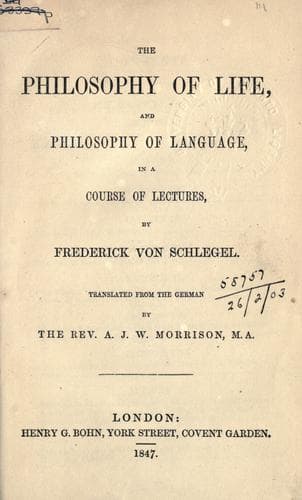
The philosophy of life, and philosophy of language, in a course of lecturesSchlegel, Friedrich von
Philosophy
The philosophy of life, and philosophy of language, in a course of lectures
Schlegel, Friedrich von
Language and languages -- Philosophy; Life; Philosophy
It is only in this sense that there can be true representatives of a
people, who, if the expression is allowable, are its true historical
men. It is in them that the spirit and character, the general leaning
tendency, the peculiar style of feeling, sentiment, and thought of a
nation, in any definite period or periods, finds its most decided and
loudest expression. Rarely, however, is this attained in a system of
elective deputies or representatives, which is liable to many passing
and accidental influences, and, indeed, in and by itself has no
connection with it. Scipio and Cato would be representatives of the
Roman character and spirit, even if they had never been invested with
public authority and had lived their whole lives in exile. And in the
same manner purely intellectual natures may often stand for such
historical characters and representatives. Horace and Tacitus most
assuredly occupy the same relation to their respective ages as the two
former did to theirs, and this, in truth, quite independently of any
subordinate rank or political dignity and influence which either the one
or the other possessed in peace or war. Cicero, indeed, would have been
all this in an equal degree, and, perhaps, still more so, if, keeping
entirely aloof from the civil contentions of his day, for which he was
little suited, he had devoted himself to the acquisition of a purely
intellectual and literary influence.
However, it is not every famous author or every brilliant political
speaker that can in this sense be justly regarded as historical
characters. Besides that energy of talent which creates an epoch, and
which is, indeed, the primary and essential condition, certain other
properties of character are required, certain sentiments and principles
vividly carried out and realized in life and action. But this is a
combination which is rarely found. A peculiar sphere of practical
influence does not form an immediate, nor, indeed, a necessary
qualification of such a character. Still it is evident that a writer who
truly merits such an appellation must be something more than a mere man
of letters or an artist. The effects he produces on the minds of men
must be both truly national and historical. Such alone are truly and
properly the historical representatives of a people--the men of their
nation.
Public-domain text, read in full here on John Shaqi.
Reviews
Reviews
No reviews yet
Be the first to share your thoughts on this work.
Elsewhere in the archive
Join the Discussion
Join the discussion
Sign in to leave a comment or review.
Sign InorCreate an account