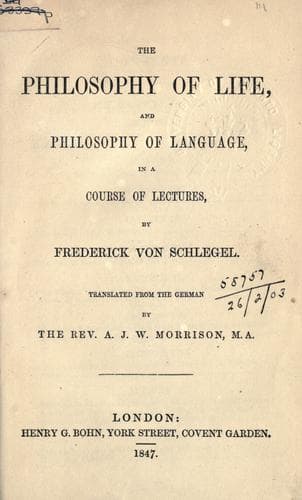
The philosophy of life, and philosophy of language, in a course of lecturesSchlegel, Friedrich von
Philosophy
The philosophy of life, and philosophy of language, in a course of lectures
Schlegel, Friedrich von
Language and languages -- Philosophy; Life; Philosophy
Accordingly, throughout the sacred history of the old world, and in all
times where religious sentiment is not quite dead, such calamities, and
even an unfortunate, not to say a wicked reign, are looked upon as the
deserved visitation of God’s wrath, and as a time of heavy trial. And
the chastisement of Heaven will be borne, by all right-thinking persons,
not out of fear of man, but as is fitting, in reverent submission to the
divine will, with manly patience and resignation. On the other hand,
innumerable instances of a contrary course might be produced from
republican times and histories. How often, in such states, has a false
step in government, trifling, indeed, in itself, but still in fact and
in truth, a blunder in one party, been the occasion of an opposition and
resistance of another, and of a general feeling of discontent and a
violent reaction, which have proved a hundred times more fatal and
pernicious than the first occasion of popular murmurs. How often has a
merely human oversight, trivial enough in itself, and running counter to
public opinion in some little trifle, led to the most fearful
catastrophes, amid which the first exciting cause is lost sight of and
entirely forgotten, and finally all is involved in one general ruin.
In this respect, and in this degree, it may safely be affirmed that the
Christian principle of the state is more favorable to an hereditary
monarchy than to a republican constitution. But at this point the
proposition must be left purposely indeterminate. For a rigorous
exclusion of all republican states, as if, properly, they could never be
right and legitimate, would most assuredly not be accordant with the
Christian principle of a state and the fundamental religious conception
of all political relations and events. On the contrary, it would,
undoubtedly, go directly counter to all proper feelings and ideas on the
subject. For the Christian principle of justice respects all that has an
historical existence, and leaves even the imperfect in the undisturbed
possession of its rights. In this respect it is entirely opposed to the
revolutionary spirit. For the latter, in its inmost essence, is
anti-historical; its first step being the refusal to recognize the value
and the claims of all that comes down from, and has been established by,
the past. And, moreover, the Christian idea of justice, with all its
strict rigor, involves a principle of equity. For, in truth, every
Christian sentiment embraces the whole of life, and its several
relations, with a loving mildness, and pays a due regard to all really
existent though subordinate circumstances. And it is this exactly that
constitutes the very notion of equity. Lastly, the doctrine of
Christianity, and the idea of human life which it gives rise to, is
highly favorable to true liberty. But, then, it is liberty, in a large
and exalted sense of the term, in which, first and before all, a
spiritual and moral freedom is meant as necessary to be firmly
Public-domain text, read in full here on John Shaqi.
Reviews
Reviews
No reviews yet
Be the first to share your thoughts on this work.
Elsewhere in the archive
Join the Discussion
Join the discussion
Sign in to leave a comment or review.
Sign InorCreate an account