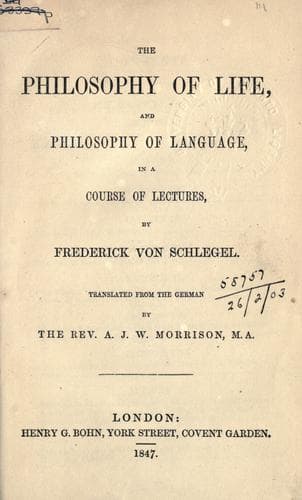
The philosophy of life, and philosophy of language, in a course of lecturesSchlegel, Friedrich von
Philosophy
The philosophy of life, and philosophy of language, in a course of lectures
Schlegel, Friedrich von
Language and languages -- Philosophy; Life; Philosophy
established within men before the external liberty in social and
political life can be hoped for. For most true is the sublime
declaration, “If the Son shall make you free, ye shall be free
indeed.”[55] To every one for whom this sentiment possesses a meaning
and significance it would be superfluous to add, what, indeed, is so
palpably evident, that the Son makes no one free except in the way that
He Himself was, viz., by obedience--a perfect obedience which brings the
whole man, with all its passions and affections, as a free-will offering
to the Father.
The predominant tendency of modern Christendom to a monarchical
constitution, as most accordant with the Christian principle of the
state, is abundantly evinced in history. The fact is so generally
admitted, that it is almost a work of supererogation to adduce instances
of it. Not only within the memory of living men, but also two centuries
ago, a great Christian monarchy, fanatically possessed and inflamed with
the idea of absolute liberty and equality, lapsed for a while into a
republic. But in both cases this passing fever of fanaticism soon worked
itself out by its very violence, and the foreign and diseased matter was
thrown off by the political body. It was out of this crisis, however,
that the much-lauded constitution of England arose, with its dynamical
theory of the division and nicely-adjusted balance of power, which has
reached at present so great a height of practical excellence. Moreover,
it is almost superfluous to notice the fact how a second-rate maritime
power, which in its very origin was entirely republican, gradually
approximated to, and has at last entirely adopted, a monarchical
polity.[56] Another state, monarchical indeed, but which, from the fact
that its sovereigns were elective, deserves rather to be called a
republic, and in some respects was really so, amid the anarchy of party
and the feuds which arose out of the elections, soon lost its ancient
greatness and splendor, and even its existence as an independent nation.
In short, in the whole of Christian Europe, but a few small and
uninfluential communities have retained a republican form. As for the
republics which have sprung up out of the colonial states in the New
World, the very oldest of them are of too recent an origin to allow us
to pass upon them any judgment which could be justly and truly called
historical. On the other hand, however, the modern Christian era
furnishes one remarkable phenomenon of a republican state on a large
scale, and of a wholly peculiar kind. And we may adduce this instance as
a proof that such a constitution is by no means excluded from the spirit
of a Christian polity or its legitimate and historical principle.
Public-domain text, read in full here on John Shaqi.
Reviews
Reviews
No reviews yet
Be the first to share your thoughts on this work.
Elsewhere in the archive
Join the Discussion
Join the discussion
Sign in to leave a comment or review.
Sign InorCreate an account