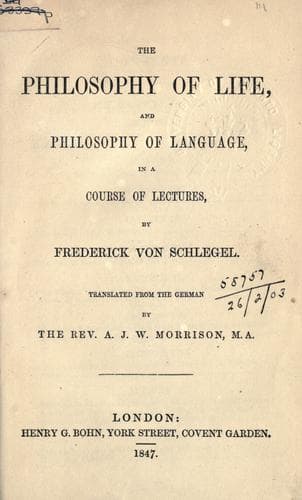
The philosophy of life, and philosophy of language, in a course of lecturesSchlegel, Friedrich von
Philosophy
The philosophy of life, and philosophy of language, in a course of lectures
Schlegel, Friedrich von
Language and languages -- Philosophy; Life; Philosophy
Modern history at no period presents to us such a vast system of
republican states as we meet with in the annals of antiquity, which
exhibit this under the most various forms, as the predominant
constitution of the whole civilized world, not only in its infant, but
in its maturest and most flourishing development. Not only the Grecian
communities, Carthage, Rome, and the Italian municipalities, but also
all the independent nations of central and northern Europe, possessed a
more or less perfect form of republican polity. This portion, therefore,
of ancient history furnishes to political science a phenomenon which in
the highest degree demands its attention. However greatly its freedom of
inquiry and high intellectual culture, its splendid examples of
patriotism and its noble characters and heroic deeds, may prepossess us
in its favor, on the whole we are forced to confess that experience has
decided against such a system. This great teacher shows it to us as
utterly impracticable, and ill adapted to promote the real progress of
human development, inasmuch as with whatever of brightest promise it may
begin, it invariably terminates in barbarism and disorder. In all of
these states we trace early enough the same evil tendency to political
license and anarchy, which, developing itself with ceaseless rapidity,
soon paves the way to the indeterminate condition of absolute power.
Almost all the great thinkers and political writers of antiquity,
without exception, set themselves to oppose the democratic element of
their national constitutions, and foresaw and predicted the ruin of
their country from this source, without being able in any way to prevent
it. It will be enough to mention Plato in Athens, and in a different
manner and degree, Cicero in Rome, who was himself drawn into the vortex
of political strife. The remedy and counterpoise for the evils of this
democratical spirit was sought by the political thinkers and
philosophers of those times, in a doubtlessly noble but still very
imperfect form of an aristocracy--a remedy which is as little consonant
to our feelings as it is unlikely to satisfy our scientific convictions.
A just and clear idea of an hereditary and well-regulated monarchy was
at that date almost entirely unknown, since in its essential features,
in its true and perfect character, it is entirely of a Christian origin.
In the ancient world, at most, a few and faint outlines of it are
occasionally to be discovered.
Public-domain text, read in full here on John Shaqi.
Reviews
Reviews
No reviews yet
Be the first to share your thoughts on this work.
Elsewhere in the archive
Join the Discussion
Join the discussion
Sign in to leave a comment or review.
Sign InorCreate an account