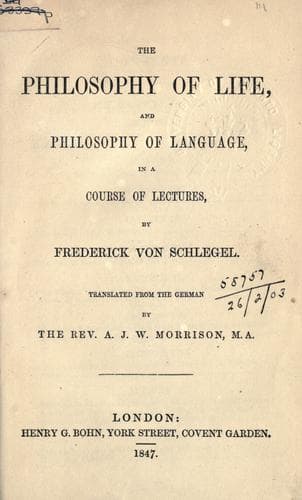
The philosophy of life, and philosophy of language, in a course of lecturesSchlegel, Friedrich von
Philosophy
The philosophy of life, and philosophy of language, in a course of lectures
Schlegel, Friedrich von
Language and languages -- Philosophy; Life; Philosophy
The usual transition and natural issue of popular anarchy, when it has
lasted long enough to exhaust its own fearful violence, is a perpetual
dictatorship or despotism in some shape or other, but devoid of a higher
and diviner sanction. This form of government, or (since, strictly
speaking, it is not a form) this political condition, must be carefully
distinguished from a long-established, legitimate, and hereditary
monarchy, with which its whole character has nothing in common. No doubt
when the revolutionary evil has reached its greatest height, and when a
successful and prudent usurper, like the much-lauded Augustus in ancient
Rome, without being personally answerable for the overthrow of the
previous constitution, appears pre-eminently in the character of
mediator between parties and a general pacificator, the world is ready
to accord to him its applause. Gradually his authority is more and more
widely acknowledged. Although at first he is recognized conditionally
only and relatively, nevertheless, if he remains faithful to his better
tendencies, and continues to the last to confer important benefits on
his people, he may often give a permanent and historical foundation to
his dynasty. But if, on the contrary, under his usurped power,
revolution, phenix-like, only renews itself out of its own ashes, and
the old anarchy from below revives in another form from above, as a
merely military despotism, which, in its resistless and annihilating
lust of conquest, honors nothing, but throws the whole world into
confusion, then is the second evil worse than the first, which it
promised to remedy. By such a course it loses its only moral foundation,
inasmuch as it was to the better promise it held out that it owed its
temporary and conditional recognition. Such an instance has been brought
closely enough before our eyes in the history of very recent times, to
enable us at once intuitively to understand its whole character. More
slowly, and in a more organized method, and, consequently, with more
lasting and historical results, did such transitions shape themselves in
the ancient world, and especially in the Roman constitution. The ancient
development, therefore, of this phenomenon, and its special form, is
highly instructive and pre-eminently calculated to throw a clear light
on our whole theory.
Public-domain text, read in full here on John Shaqi.
Reviews
Reviews
No reviews yet
Be the first to share your thoughts on this work.
Elsewhere in the archive
Join the Discussion
Join the discussion
Sign in to leave a comment or review.
Sign InorCreate an account