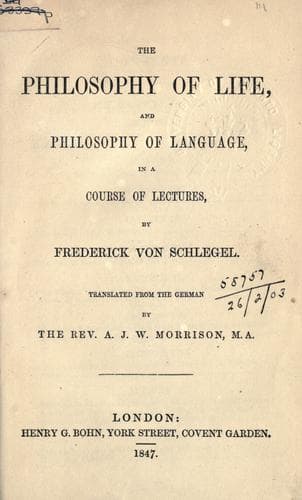
The philosophy of life, and philosophy of language, in a course of lecturesSchlegel, Friedrich von
Philosophy
The philosophy of life, and philosophy of language, in a course of lectures
Schlegel, Friedrich von
Language and languages -- Philosophy; Life; Philosophy
The essence of despotism, as I said before, lies in the union in one
person of the civil and spiritual powers--or in a most anomalous state,
which is, by a rare and faulty combination, at once spiritual and
temporal. And since the distinction between the two powers is involved
in the very notion of a Christian state, it is of the highest importance
that the state should carefully observe and respect the boundaries
between the two domains. It is extremely difficult to establish any
general standard for all the cases of collision between the two that
either have actually occurred or are conceivably possible. For it is
evident that this contingency must be modified in an infinite number of
ways, by existing treaties, the local circumstances and political
constitution of the different states. The chief point is the general
spirit and feeling. The question turns principally on good will and
honest intentions; but pre-eminently on a right conception of both
powers, as alike possessing in their respective spheres a higher
sanction, a divine foundation, and a sacred character. This must be
recognized in every case and time, and all circumstances belonging to
either sphere must be treated accordingly.
Many and serious cases of such collision between the church and the
state have occurred and are perpetually recurring. Many and grave errors
have been committed on both sides. But for the most part they have been
unfairly judged, or, rather, misjudged, through ignorance both of the
times, and of the actual circumstances of the case. The day is not long
gone by when in this respect it was the habitual rule to subject certain
of the early popes especially to an unqualified vituperation and
censure. And it must be told, to the praise of German impartiality, that
Protestant writers were the first, by their historical researches, to do
justice to and to form a fair estimate of these, in their day, truly
great and eminent characters. Still we do not by any means pretend to
deny that both in these and later times grave blame rests with many of
the popes individually. On neither side, however, and at no time, were
the limits which divide the two powers overstepped so far as they were
by Henry VIII. of England, that absolute monarch in temporals, and who
wished also to be equally supreme in spirituals. The most despotic
sovereign that ever sat on the throne of England, by founding [the
independence of] the Anglican Church,[59] became undesignedly and
unconsciously the true author of that much-lauded constitution of
England, which, essentially resting on this foundation, furnishes the
only instance of a dynamical polity, as the only remedy of an otherwise
incurable tendency to division and anarchy, attaining to a highly
perfect shape and development. As for the schism in the faith, which in
these latter times has in so many Christian countries made the problem
of religion only the more difficult, and its relation to the state more
Public-domain text, read in full here on John Shaqi.
Reviews
Reviews
No reviews yet
Be the first to share your thoughts on this work.
Elsewhere in the archive
Join the Discussion
Join the discussion
Sign in to leave a comment or review.
Sign InorCreate an account