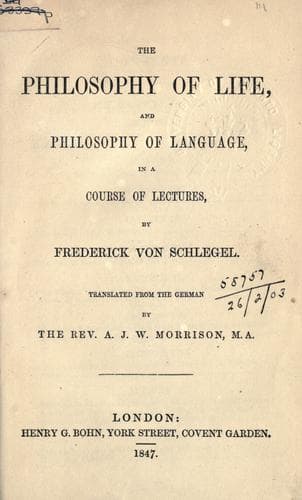
The philosophy of life, and philosophy of language, in a course of lecturesSchlegel, Friedrich von
Philosophy
The philosophy of life, and philosophy of language, in a course of lectures
Schlegel, Friedrich von
Language and languages -- Philosophy; Life; Philosophy
delicate and liable to aggression, it has in England, through this
royal reformer, assumed so complicated a shape that, unsolved as yet, it
appears to many, judging of it in a merely human light, totally and
forever incapable of solution.
We must reserve to the succeeding Lecture the enumeration of all the
results which flow from these premises, and this first outline of a
truly Christian justice, which as such involves the principle of equity,
and is even truly historical.
LECTURE XIV.
OF THE DIVISION OF RANKS, AND OF THE RECIPROCAL RELATIONS OF STATES
ACCORDING TO THE CHRISTIAN IDEA.--OF SCIENCE AS A POWER; OF ITS
CONSTITUTION, AND OF THE RIGHT REGULATION OF IT.
Whenever philosophy, setting up any conceit of its own as a principle,
intrudes either into the domain of religion or of politics, such an
intrusion is, in every case, an aggression. And if the aggressive idea,
once formed and entertained, is, nevertheless, externally and in
appearance held in check and restrained--if, from ulterior
considerations and for the sake of some remote object, science
accommodates itself to the established system of law or religion--then
is the case only so much the worse. The deep and pervading hostility of
sentiment is but concealed beneath the external servility of language,
and the rankling wound has but skinned over the surface. The influence
of evil is far from being checked and destroyed; or, to say the least,
that of good is nipped in the bud, not being allowed fully to expand
itself. And at the same time the dignity of science, which can only be
maintained by its independence, is fatally and irretrievably endangered.
Under this conviction, I strongly protested, at the very opening of
these Lectures, against all such intermeddling of philosophy with
matters foreign to it; and I trust that, for my part, I have hitherto
duly observed the spirit of that protest. But now, the end which
philosophy strives to attain to is a right estimate and full
understanding of its own nature, and that of man, both in the internal
properties of his mind and in his external existence relatively to God
and nature, and also to the world and society. In pursuit of this
object, having once found and acknowledged the center of the inner life,
such as it is given to us, and setting out therefrom, philosophy can and
may, with perfect propriety, submit to investigation the highest ideas
of life, and judge them after its own method, and from its own peculiar
position. But still it will do this in the hope rather of explaining
what actually exists, than of establishing any self-devised ideal of
its own, or of setting up impracticable laws for a merely conceivable
state of things under the most arbitrary assumptions--for a wholly
visionary world.
Public-domain text, read in full here on John Shaqi.
Reviews
Reviews
No reviews yet
Be the first to share your thoughts on this work.
Elsewhere in the archive
Join the Discussion
Join the discussion
Sign in to leave a comment or review.
Sign InorCreate an account