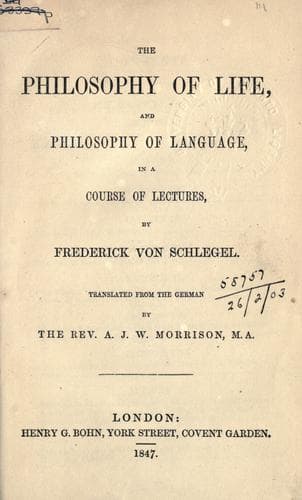
The philosophy of life, and philosophy of language, in a course of lecturesSchlegel, Friedrich von
Philosophy
The philosophy of life, and philosophy of language, in a course of lectures
Schlegel, Friedrich von
Language and languages -- Philosophy; Life; Philosophy
The only opposition, therefore, that the spiritual power can rightly and
justly make to the aggression of the state must be of a passive nature.
It is not necessary to lay down any elaborate and rigorous distinctions
for such an emergency; for such definitions rarely meet the complicated
variety and special character of every possible or even every actual
case. A few historical examples, which readily present themselves, will
serve briefly and perspicuously to illustrate the view of duty which we
wish to enforce. In the unfortunate case of a great and public collision
between the Church and the State, the model of a just and legitimate
resistance on the part of the spiritual power has been furnished by the
conduct of that venerable old man,[60] whom half of Europe regarded as
invested with the highest priestly and apostolical dignity. With calm
fortitude, even in bonds, he refused to yield to the military despot,
and won the personal esteem and admiration likewise of that other half
of Europe which denied his spiritual authority. Or, to take an example
from a more limited sphere, and of a more personal nature, we may appeal
to the history of the patron saint of Bohemia, which, at least, can not
be classed among the legends, and which, in any case, will afford a
beautiful and simple example of a noble, perfectly-allowable resistance
of a spiritual party against the injustice of the political head of the
nation. By such passive resistance, and by such alone, did Christianity,
in the earliest centuries, though so unattractive and so lowly at its
first commencement, gradually attain a secure external foundation, and
become the religion of the whole civilized world. A public outbreak, and
even a secret feeling of discontent between the spiritual and the
temporal power, between Church and State, is, at all times, and in every
case, a great evil, threatening and bringing danger and ruin on both.
For the state, as being ultimately founded on a religious basis,
undermines its own foundation by assuming a hostile attitude toward
religion. No financial difficulties, or any such partial calamities,
will ever ruin a people so long as any moral energy still exists in the
whole body, and it is consequently sound at the core. Political
skepticism, which is the immediate and necessary consequence of
infidelity in religion, is the true cause and origin of the decay of
nations. These two vital principles of human society, therefore--these
two powers, however essentially and necessarily distinct--must work
together in perfect peace and unity. For the one can only flourish where
the soil has been rendered morally fertile by the other, while the
latter can not exercise its full influence except under the sanction of
the political power. If religion were at unity in itself, and totally
free from party and controversy, and the state, as the public life, were
in perfect harmony with it, and thoroughly pervaded by its life-giving
Public-domain text, read in full here on John Shaqi.
Reviews
Reviews
No reviews yet
Be the first to share your thoughts on this work.
Elsewhere in the archive
Join the Discussion
Join the discussion
Sign in to leave a comment or review.
Sign InorCreate an account