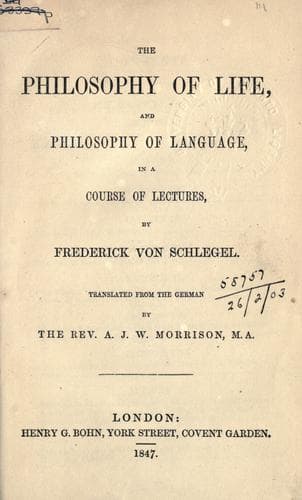
The philosophy of life, and philosophy of language, in a course of lecturesSchlegel, Friedrich von
Philosophy
The philosophy of life, and philosophy of language, in a course of lectures
Schlegel, Friedrich von
Language and languages -- Philosophy; Life; Philosophy
Besides the many other traces of family affinity between the Indian and
Teutonic races, another is furnished by the Germanic constitution, which
forms the political basis of most European kingdoms. In India the noble
class who most especially are bound to military service forms also the
caste of the lords of the soil; and from their latter character they
also derive their name as a class.[61] Some of the most general and most
ancient features of the feudal system have likewise been discovered
among them, though not, indeed, its more artificial and complicated
system, to which feudalism was in later times developed among European
nations. To this landed nobility belong the nabobs and even the rajahs.
For it was left open to the fluctuating fortunes of different families
to rise or to fall from the summit of political dignity. Between the
several grades of honor accessible to a particular caste no
insurmountable barrier was raised; all were open to all the members of
the same rank or caste.
The democratical writers of a recent era, in obedience to a sentiment
natural enough to their false system, have expressed a deep horror and
strong aversion to this institution of castes among the Hindoos,
stamping it on every occasion with the strongest marks of reprobation.
Viewing it, however, in an historical light, I for my part am disposed
to think that it is to this ancient and hereditary institution, however
much of imperfection it undoubtedly involves, that this great and
populous country owes that firm stability of its laws and customs, and
that indestructible prosperity which the various conquests it has
undergone both in ancient and modern times have been unable to shake or
to undermine. No doubt the Indian gradation of ranks wants the stamp of
perfection and mildness which belongs to Christian politics. And in this
respect the comparison is especially instructive. It serves to draw
attention to, and strongly illustrates the fact, that a Christian
division of ranks is, in some points, different in its principle, and
the very opposite to the correspondent state of things in the old world,
as yet unrefined and purified by this divine element. For, first of all,
according to the Christian idea, the spiritual class can not depend upon
birth; it must possess a higher and peculiar vocation. This order,
consequently, can not recruit itself merely by birth, but must derive
its members from the other classes which are hereditary. But in
consequence of this principle, the partition-wall, otherwise impassable
and absolute, between the other ranks, which, taken on the whole, are
hereditary, is so far removed, that exceptional cases occur when these
barriers are opened to merit or other important considerations. It is a
self-evident fact, requiring no elaborate argument for its proof, that
the Christian sentiment, or, as we have here expressed it, that
principle of equity so universally and essentially interwoven with the
Public-domain text, read in full here on John Shaqi.
Reviews
Reviews
No reviews yet
Be the first to share your thoughts on this work.
Elsewhere in the archive
Join the Discussion
Join the discussion
Sign in to leave a comment or review.
Sign InorCreate an account