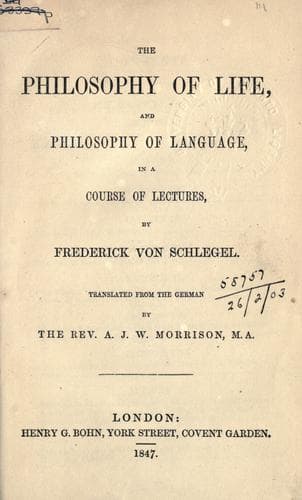
The philosophy of life, and philosophy of language, in a course of lecturesSchlegel, Friedrich von
Philosophy
The philosophy of life, and philosophy of language, in a course of lectures
Schlegel, Friedrich von
Language and languages -- Philosophy; Life; Philosophy
Christian idea of justice, demands that every alleviation of their
toilsome and oppressive lot should be afforded to the industrious
classes. To those on whom the accident of birth, as the world speaks,
or, as we should prefer to say, a higher and a divine Providence, has
laid all the hardships of life, it is but just that every privilege
should be conceded that does not militate against the general welfare,
or the private rights of individuals. And in the same spirit, every
political constitution that is organically arranged and founded on a
Christian, and, consequently, modified separation of ranks, will
attentively observe and engraft into its old constitutional stock every
new historical shoot. A great and instructive example of the kind is at
hand. In the Teutonic constitutions of the middle ages, and especially
in the Germanic Empire, cities and trades, which at an earlier period
had formed a very immaterial and comparatively insignificant element in
the whole--in short, the growing burgher classes were, at their very
first appearance, understood humanly and politically--received a great
organic development, and taken into a living combination with the old.
In all probability our own deeply-agitated times, which assuredly
deserve not to be called unfruitful, even though, together with the good
fruit, they may also produce many a false blossom, give birth to much
that is new indeed, but which is, nevertheless, or at least may
eventually become, historical. The phenomena of the present, therefore,
demand our most careful consideration, lest any negligence in this case
should inevitably involve us in disaster, and bring on us a natural
historical retribution. An exclusive and narrow aristocracy, or, if we
must say so, one senselessly insisting on its privileges, such as in the
earlier part of the last century was probably to be met with in a few
countries, is, to the true friend of the ancient order of things, the
most painful phenomenon. It is its own greatest enemy--since, by an
historical law of antagonism and reaction, one extreme inevitably calls
forth the other sooner or later. Hereditary monarchy, as it is the
oldest form of polity in history, so, if it is maintained in the mild
and moderate spirit of the Christian state, is likely to survive all
others, and to be the last in force among the human race; for a state
which is founded and established on the Christian principle of an
equitable distinction and division of ranks, must, in every calm and
unprejudiced judgment, deserve the preference over the artificial
constitution of a dynamical balance of powers; for the necessary
equipoise is liable to be disturbed by the restless agitation to which
the latter form of polity is exposed. And it is only, therefore, in
comparison with an absolute despotism that the dynamical theory can
appear desirable and win so many adherents, while the former, on the
other hand, as the only remedy for popular anarchy, if administered with
Public-domain text, read in full here on John Shaqi.
Reviews
Reviews
No reviews yet
Be the first to share your thoughts on this work.
Elsewhere in the archive
Join the Discussion
Join the discussion
Sign in to leave a comment or review.
Sign InorCreate an account