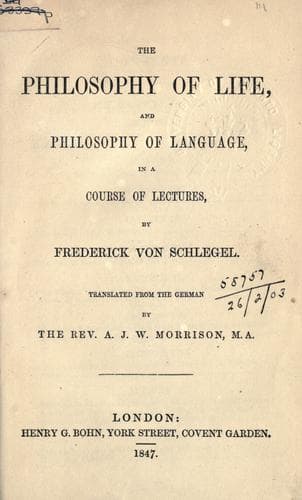
The philosophy of life, and philosophy of language, in a course of lecturesSchlegel, Friedrich von
Philosophy
The philosophy of life, and philosophy of language, in a course of lectures
Schlegel, Friedrich von
Language and languages -- Philosophy; Life; Philosophy
Since then, however, the great powers of Europe have had a different
interest to pursue, and their political counsels have been directed to
the preservation of peace rather than to selfish aggrandizement. For
they have all had to contend with a common enemy in the restless spirit
of the age, which is yet very far from being conquered and subdued. If,
then, an absolute preponderance of a single state is hateful to all, and
a dynamical balance of power in the general state-system is either
inadequate for such an end, or else does not admit of application, is it
not at least conceivable that a higher principle of Christian justice
might be substituted for these which are equally defective? Might not a
common point of moral unity be found and established for the European
states? Must this sublime idea ever be nothing more than the noble
enthusiasm of a magnanimous character? And is it to be regarded as
impossible merely because it is imbedded in difficulties? But is not all
that is great also difficult? Still, inasmuch as this exalted political
unity must have a purely spiritual basis in the sentiments of men, a
precipitate or violent attempt to bring it about must inevitably
miscarry. It would not only militate against, but also corrupt the
original purity of the very idea. It must be universally recognized
before it can, in the contest with the evil principle of the day, become
a salutary power of good, or furnish for the political relations a
general basis of Christian justice. The one extreme of political Europe,
with its absolute polity, which moreover has fallen very low from its
former preponderance, seems excluded by the very nature of things from
the idea of such a unity. But if it be true that it is gradually
becoming more and more European, a character in which, until very
lately, it has rarely been regarded, then a modified kind of subordinate
connection with such a general principle of association among European
states, does not seem necessarily inadmissible or inconsistent. The
other extreme of Europe, with its dynamical constitution, had, in an
opposition, moderate indeed in form and conditionally, more than half
renounced this idea. In the opinion, however, of many competent judges,
this renunciation is much more decided, and must exercise a great and
unfavorable effect on the harmony of the whole. The moral want of our
age, judged by this or some similar idea, is the necessity which was so
keenly felt upon its deliverance from the general yoke of a military
aggression, of a moral and intrinsic regeneration of Europe. And this
unity is not to be derived from and set up merely in science, but must
be felt as a living energy in life itself. But how is such an inner
restoration to be brought about and effected in Christian states, but by
a complete renewal and invigoration of their religious foundation? And
inasmuch as this want actually exists and is felt, the problem which is
Public-domain text, read in full here on John Shaqi.
Reviews
Reviews
No reviews yet
Be the first to share your thoughts on this work.
Elsewhere in the archive
Join the Discussion
Join the discussion
Sign in to leave a comment or review.
Sign InorCreate an account