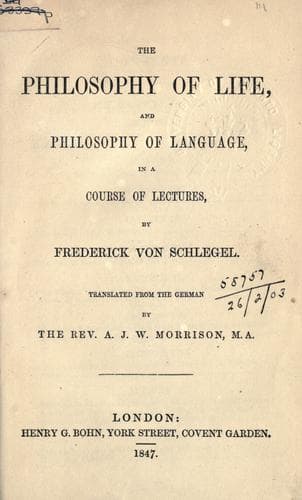
The philosophy of life, and philosophy of language, in a course of lecturesSchlegel, Friedrich von
Philosophy
The philosophy of life, and philosophy of language, in a course of lectures
Schlegel, Friedrich von
Language and languages -- Philosophy; Life; Philosophy
to supply it must be regarded as an historical one; and consequently the
historical development of the times--abstracted from the accidental form
of the first essays at its solution--will sooner or later carry us to
all that is most essential in the idea.
Formerly, in the medieval times, the German Empire claimed to be this
Christian center of unity for the states of Europe--although, in truth,
it was far from embracing the whole system of European states. Latterly,
in the new political theory, the mutual relation of nations has become
gradually republican. And this new form has consequently been
accompanied with imperfections and difficulties and almost inextricable
perplexities. Is it, then, probable that in the commencing or
recently-commenced era of history, a firm, compact, but vast corporation
of states, founded on a principle of Christian justice, can be
substituted for and gradually evolved out of the two previous ones,
which are now found wholly inadequate for the ends they were designed to
meet? As a mere historical probability we may well allow this idea to
stand.
Totally different from those idle speculations of an endless peace,
which, for the sake of mere intellectual amusement and discussion,
philosophy was used to advance in the schools, is this thoroughly-practical
thought of a confederation of states based on the principle of
Christian justice and vitally connected with religion as the most
general center of humanity. And the latter must be regarded as the
essential condition of its internal consistency and permanence.
At least we may safely advance the following as the result of a
philosophical consideration of history. An exalted and universal
religious peace of this kind, and proceeding from such a principle, in
which, by a peaceful approximation, not only the two parties in the
faith should be reconciled and finally united, but also the spiritual
and the secular powers, the Church and the State, should be allied
together in the profoundest harmony, is, properly speaking, the very
thing which mankind most stands in need of. But this desirable result
never can and never will be attained until all shall be united in
pervading harmony with religion and with life, especially with public
life or the state, so that all these three principles or fundamental
elements of human existence may work together with one aim and purpose.
Such a state of profound internal peace would be something more than
a simple political peace, with its transient blessings. It would be a
sacred peace of God and the higher spirits, or at least the precursor
and the best initiation thereto. This, however, is not to be effected
by diplomatic skill no more than by scientific hypotheses. It can only
be brought about by the immediate operation of God, and by that divine
energy which from the beginning has sustained and still sustains the
system of the universe. Philosophy, accordingly, must content itself
Public-domain text, read in full here on John Shaqi.
Reviews
Reviews
No reviews yet
Be the first to share your thoughts on this work.
Elsewhere in the archive
Join the Discussion
Join the discussion
Sign in to leave a comment or review.
Sign InorCreate an account