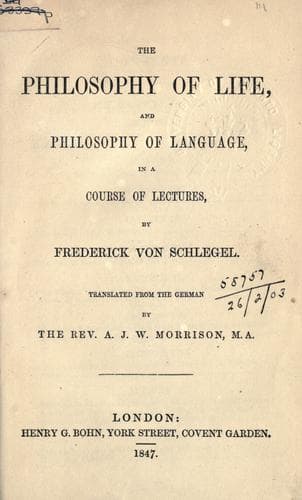
The philosophy of life, and philosophy of language, in a course of lecturesSchlegel, Friedrich von
Philosophy
The philosophy of life, and philosophy of language, in a course of lectures
Schlegel, Friedrich von
Language and languages -- Philosophy; Life; Philosophy
If, as we are perfectly justified, we have been considering science, at
least that which is true and divine, as a power of a higher kind, we
must still remember that it is not so in the same way as religion or
government. The latter rests on a divine foundation of eternal justice;
and therein lies the source of its vital efficacy. Religion is the
legitimate form of a living dispensation of the divine strength and
grace. True science is the mind’s lofty pursuit, in a Godward direction,
of perfect knowledge; and this direction forms the characteristic
distinction between it and false science. In the state, in like manner,
its loftiest character lies in the sacred foundation of justice. It is,
therefore, a very wrongful and a most pernicious error to look for the
inmost essence of the state, or the true source of political prosperity,
in any external form or formula. For this external form is in many cases
nothing but the shape in which the national mind displays itself--the
theater which it erects for its political manifestations. But, in
another point of view, also, the form of the state is subordinate to the
essence and its foundation of right. In the legitimate state, an
hereditary monarchy, _i.e._, the act of crowning, is, no doubt, a very
beautiful, highly significant, and, indeed, an essential sacred right.
But, with the exception of certain special cases and positive
institutions in some existing constitutions, the monarch’s right is not
dependent thereon, but even before the anointing he is truly and fully a
sovereign. Far different is the case, however, where the political
authority is only delegated and vicarious, as with an ambassador or a
plenipotentiary deputed to negotiate a peace, or other treaty. For in
such cases there is no authority but what is derived solely and entirely
from the delegating source, and on the legal act by which the right or
power was delegated. Without this, it is absolutely null and void. This
remark extends to every case and every sphere of legitimate transference
of a higher authority, even though the latter be of a divine origin. And
it is simply on this account that in religion, as the proper sphere for
the dispensing of divine strength and grace, the form is so highly
important and so thoroughly essential--even as much so as the matter
itself--or the imparted light of the spirit, and properly is inseparable
from it.
Public-domain text, read in full here on John Shaqi.
Reviews
Reviews
No reviews yet
Be the first to share your thoughts on this work.
Elsewhere in the archive
Join the Discussion
Join the discussion
Sign in to leave a comment or review.
Sign InorCreate an account