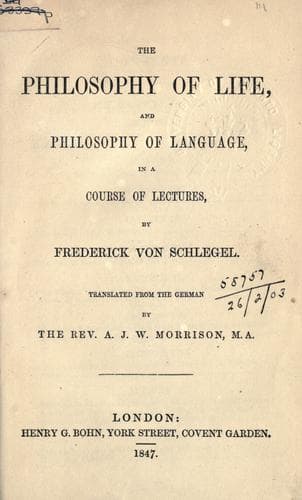
The philosophy of life, and philosophy of language, in a course of lecturesSchlegel, Friedrich von
Philosophy
The philosophy of life, and philosophy of language, in a course of lectures
Schlegel, Friedrich von
Language and languages -- Philosophy; Life; Philosophy
The position of science is quite different. For this rests on what is
thoroughly human and inborn in man--the passion of longing; which,
however, if it be maintained in its purity and perseveringly carried
out, may, without doubt, pass over into a divine pursuit. Even the form
of communication in science is human throughout, since it employs
language as the intellectual medium for setting forth the truth. If,
then, in this higher tendency, the full center of living and divine
truth be attained, according to man’s utmost powers and ability, then,
even here, a higher and divine power may, undoubtedly, intervene and
co-operate therewith. But still, for such a case, no strictly-defined
form, or external sanction and consecration, exists, and from the very
essence of the thing, it is not to be looked for. That which is divine
in science must, from its nature, move freely, and be devoid of all such
forms. As a higher power, it must operate immediately, and must seek to
establish its own law for itself, intermediate between religion and the
state, or even in each of them alike, though still in a peculiar way of
its own. Wherever it is genuine and unadulterated, then it will in no
case come into collision with the actual laws either of one or of the
other, even because truth is one and every where the same. But if
science, in its external form, and in its social and political
existence, should become entirely blended with religion and the
spiritual class, being confined and restricted thereto, as was the case
with the institution of castes among the Hindoos, which we have already
noticed, and with the Egyptian priesthood, then we must fain admit that
freedom, which the scientific spirit requires for its growth and
development in the sphere assigned to it, would be too closely limited
and checked by narrow and partial considerations. But if, on the other
hand, it be possible for a false science to arrogate that spiritual and
divine right of free action, which, unquestionably, is in a certain
sense the prerogative of heavenly truth in its invisible kingdom, which
the latter can neither misemploy, nor ever impede in its course, then
such a supposition would account for the prevalence of error. It would
also, at the same time, serve to illustrate the mode by which such a
prejudice as the arrogated right of an unrestricted freedom of thought,
or, rather, of the free and unchecked communication thereof, could ever
have struck so deep a root in the human mind. But this is a claim which
we can in no way recognize, or allow, as really founded in right and
justice. Since, wherever, as is the case in this sphere of purely
intellectual operation, all is immediate and without a definite form of
external sanction, there any thing like right must at most be indefinite
and individual.
Public-domain text, read in full here on John Shaqi.
Reviews
Reviews
No reviews yet
Be the first to share your thoughts on this work.
Elsewhere in the archive
Join the Discussion
Join the discussion
Sign in to leave a comment or review.
Sign InorCreate an account