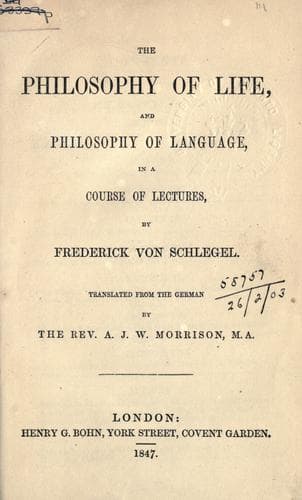
The philosophy of life, and philosophy of language, in a course of lecturesSchlegel, Friedrich von
Philosophy
The philosophy of life, and philosophy of language, in a course of lectures
Schlegel, Friedrich von
Language and languages -- Philosophy; Life; Philosophy
In reference to, and as contrasted with, the above characteristics of
genuine revelation, there is for the most part in systems of imposture
as little really new as actually old. This is especially the case with
the doctrine and Koran of Mohammed, however much it may have been lauded
for its poetry, or on account of the rhetorical art and vigor which it
displays. Its subject-matter and doctrines are not really new, since
they are but recasts of Jewish and Christian ideas, which it has freely
borrowed, mixing them together and adapting them to an obvious end and
design; and yet not old, since it does not go back far enough or deep
enough, and never remounts to the first beginning of nature and of man,
far less to the threefold fountain of divine life.
Now, with respect to Moses: an historical judge of the ordinary kind,
who could not enter into the religious view of his character and office,
might say, “This is quite a strange world to us, a very remote period;
much is there in this history difficult to explain and extremely
obscure. This much, however, seems to follow from the whole history: the
man possessed extraordinary mental powers for his times, and an equally
uncommon strength of character; no wonder, then, if he bore down all
obstacles, and by the force of genius carried every thing before him.”
Such an estimate, however, reduces every thing to the force of genius in
an heroic character, instead of a higher and immediate operation of
divine power and the prophetic office founded thereon. Superficially
judging this false view, eluding, or, rather, perverting, the divine
illumination, admits of an application, though delusive and specious
enough, to Moses, on account of those ample powers of genius which, no
doubt, he possessed, or even on account of the sublimity of his style,
which the very heathens could appreciate and admire. Still, it is in no
way applicable to that line of men, for the most part of the very
simplest character, who succeeded him, and during the period of the
theocracy down to the time of the kings, held what was immediately a
divine or prophetic rule. It was not by any hereditary title or formal
choice that they ruled; neither were they priests any more than Moses.
Called immediately by God to the dignity of judge, they suddenly stood
before the people, to be instantly and without opposition acknowledged,
and thereupon their mission and authority were at once established,
without any external sanction or solemnities, or any form of legal
recognition.
Public-domain text, read in full here on John Shaqi.
Reviews
Reviews
No reviews yet
Be the first to share your thoughts on this work.
Elsewhere in the archive
Join the Discussion
Join the discussion
Sign in to leave a comment or review.
Sign InorCreate an account