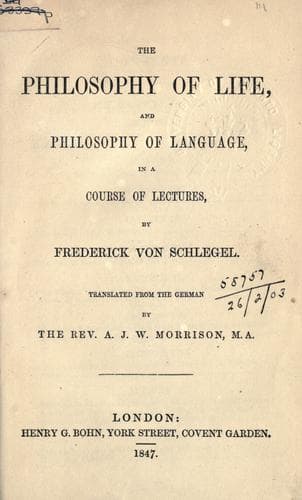
The philosophy of life, and philosophy of language, in a course of lecturesSchlegel, Friedrich von
Philosophy
The philosophy of life, and philosophy of language, in a course of lectures
Schlegel, Friedrich von
Language and languages -- Philosophy; Life; Philosophy
For a power emanating from God, and truly divine, would never violate or
forcibly subvert any established right, whether essentially sacred or
hallowed only by prescription. It will respect the least privilege of
equals and inferiors no less than the greatest prerogative of superiors.
I have introduced these remarks in order to determine more precisely the
right point of view for an historical comparison of Moses with every
other character that sets himself before the world in the same light,
whether the parallel be made with Mohammed, or that still earlier Indian
Mohammed who is usually called Buddha, although this is only an honorary
epithet, and not the name of any historical person in particular. And
the same standard will hold good for our judging of any other reformer
of the world who makes religion the instrument of his ambition, to
whatever age he may belong, or any modern Mohammed, in whatever part of
the world he may arise.
As regards the religion itself, or the matter of the pretended
revelation, there is another characteristic mark by which we may
distinguish a genuine from a spurious mission from God. Although it is
both external and negative, still, as being historical, it deserves to
be here adduced. It is this: a genuine revelation is, in the doctrine
which it promulgates, at the same time both old and new. It is new in
regard to its novel application to life and in its fulfillments, and
also to its animating force and spiritual awakening; but old in so far
as invariably referring to an earlier revelation and to a still older
source of light, it remounts up to the pure fountain of eternal truth.
And such is, throughout, the case even with the Mosaic revelation. It
continually leads the inquirer back to some higher and remoter
source--some deeper spring of everlasting light. And on the same
principle it also has been acknowledged as such by the Christian or
divine philosophy of the Spirit, and Moses has been recognized and
honored from all time as its founder. In the domain of religion, to be
absolutely new is equivalent with being false or groundless, namely,
totally detached from the old and everlasting foundations, without
connection therewith, and, consequently, isolated and arbitrary.
Public-domain text, read in full here on John Shaqi.
Reviews
Reviews
No reviews yet
Be the first to share your thoughts on this work.
Elsewhere in the archive
Join the Discussion
Join the discussion
Sign in to leave a comment or review.
Sign InorCreate an account