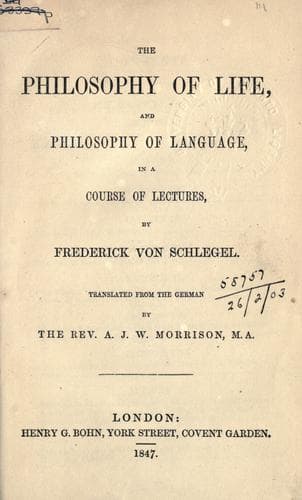
The philosophy of life, and philosophy of language, in a course of lecturesSchlegel, Friedrich von
Philosophy
The philosophy of life, and philosophy of language, in a course of lectures
Schlegel, Friedrich von
Language and languages -- Philosophy; Life; Philosophy
The preceding remarks will, I hope, be sufficient to throw out, in
perfect distinctness, the true idea of a theocracy, such as it has been
historically developed. For inasmuch as in the present age, and amid the
party disputes which mark it, this idea has been employed in so many
various acceptations, and mostly in a false or partial sense, I thought
it expedient, in the present place, not to omit to sift the question to
the utmost. Now, in a very remarkable manner, a single element, from the
earlier and original theocracy of the olden time, still survived among
the Jews in the period of the monarchy. It formed no longer indeed the
supreme power of the state, for this was held by the kings, but
constituted formally and avowedly an antagonism to them, as a
well-defined opposition, which, so long as it confined itself within its
due limits, was altogether righteous and justifiable, and which we may
justly designate as legitimate and divine. In this light we must view
the position of the later prophets, who, without, however, being
invested with any special political dignity or power, dared to raise,
before a vicious government--or, since in those simple days of old every
thing was more or less personal--before a wicked king who had forgotten
his high vocation, the voice of warning or denunciation. This peculiar
form of a political opposition, and, as such, recognized to be
legitimate and allowable, this remnant of the once exclusive theocracy
and a complete supremacy of the prophets, which still survived in the
time of the kings, forms a phenomenon as highly remarkable as it is
singular in its kind. And those who have no admiration but for
opposition, might, perhaps, if they could disentangle themselves from
the forms of their own days, or the notions imbibed at school, find here
an object altogether worthy of their praise. They might probably find
the duties of an uncompromising and yet justifiable and lawful
opposition to the state discharged by an Elijah with equal, if not
greater intelligence, strength of mind, and energy of character, as well
as sense of justice, as by the Ephori in Sparta, or a Demosthenes in
Athens during the Macedonian ascendency, or by the most virtuous of the
censors, and the most upright of the tribunes of the people in old Rome;
or even by the parliament of England. It was only in the last period of
the total decline of the Israelitish nation, and shortly before and
during the first days of the Roman dominion, that the regal dignity and
the office of High Priest were united in one family (for even here they
were not invariably associated in the same person), in such a manner as
to correspond with the notion that is at present usually understood by
the term theocracy.
Public-domain text, read in full here on John Shaqi.
Reviews
Reviews
No reviews yet
Be the first to share your thoughts on this work.
Elsewhere in the archive
Join the Discussion
Join the discussion
Sign in to leave a comment or review.
Sign InorCreate an account