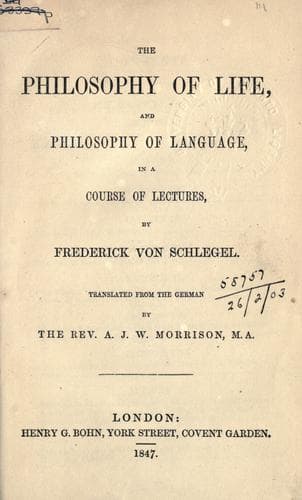
The philosophy of life, and philosophy of language, in a course of lecturesSchlegel, Friedrich von
Philosophy
The philosophy of life, and philosophy of language, in a course of lectures
Schlegel, Friedrich von
Language and languages -- Philosophy; Life; Philosophy
Far otherwise, however, was it, in this respect, with the Christian
world. The first apostolical preachers of the new doctrine of grace and
founders of an era which was truly, and in a divine sense, new,
undoubtedly did not possess less of that immediate miraculous power than
even a Moses or an Elijah. But the only use they made of it was to
promote the diffusion and to set forth the glory of religion. Once only
did the first of the Apostles, for the sake of preserving the
hierarchical authority, and the purity of the community which professed
to give up itself and all that it had to God, make a retributive use of
the divine authority committed to him. He who for the love of money was
false to the cause of God and of truth, was struck dead by the avenging
glance of him who in will was united with God as the everlasting Judge.
Never did the Apostles employ their power against the state, or avail
themselves of it in opposition to its decrees. And yet the despotic
measures of the Roman Government toward the degraded nation it had
brought, by force of arms, under its oppressive yoke, might seem, at
least, to justify such an interference with its unlawful usurpation. Not
even in self-defense, or to escape from afflictions or bonds, did they
once employ the theocratic powers committed to them.
The idea of a theocracy which is entertained in the present day is so
loose and shifting, and its application generally so erroneous, that it
is necessary to show, at length, how little the common views of it are
founded on truth. There exists no foundation for them in the view or
theory of a Christian state in its first and simple origin. And as
little is it the case with the succeeding epochs of Christianity. Such
extraordinary powers, as were manifested from time to time and intrusted
to particular individuals, have ever been employed for the diffusion of
the faith, its internal development, or to glorify it before
unbelievers, or for a new confirmation of old truths, but never for the
purpose of founding a temporal power or political influence.
Public-domain text, read in full here on John Shaqi.
Reviews
Reviews
No reviews yet
Be the first to share your thoughts on this work.
Elsewhere in the archive
Join the Discussion
Join the discussion
Sign in to leave a comment or review.
Sign InorCreate an account