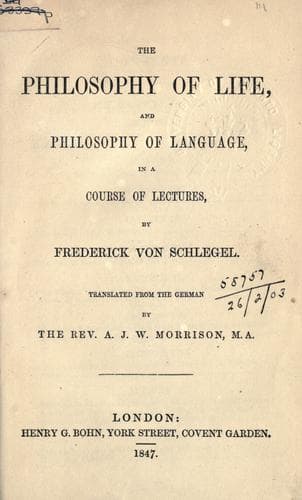
The philosophy of life, and philosophy of language, in a course of lecturesSchlegel, Friedrich von
Philosophy
The philosophy of life, and philosophy of language, in a course of lectures
Schlegel, Friedrich von
Language and languages -- Philosophy; Life; Philosophy
The true theocracy, however, such as it has actually manifested itself,
does not depend on any particular theory, but, as an immediate power and
authority from God, is regulated by the divine will alone. It would,
therefore, be precipitate, if judging of it, _à priori_, by any
arbitrary principle, we should unconditionally pronounce its recurrence
to be impossible. Generally, the wonder of a theocracy must be judged of
historically in the light in which its own history exhibits it. A mere
theory can lead us to no stable determination regarding it. The
following seems its relation to the natural history of man, or, even, we
may say, to the usual course of external nature. Viewed generally, and
in its principle, whatever is, comes from God, as its first cause. The
permission of evil, however, whether in the realm of nature or of
humanity, when, after their first divine impulse, they are left for a
time to pursue their own course of internal development, is clearly
something of another and peculiar kind. Peculiar, too, are the higher
authorities which exist in the latter, and which are ultimately founded
on a divine law and right, and somewhat different is the case with their
immediate divine operation and miraculous agency. As, therefore, the
course of the world, on the whole, is natural, and whatever transcends
it as a singular or rare exception, does but interrupt the regularity of
the ordinary laws of nature; so, too, the course of universal history,
in ordinary times, is agreeable to man’s nature, as regulated and
modified simply by historical circumstances. At most a few theocratical
junctures, a few eminent moments of a more divine working and
development of power, may be noticed at distant intervals. And these
grand and pregnant epochs, in which all the existing relations of the
world assume a new and unexpected form, are generally, in the first
moment of its triumphant result, or scarcely-hoped-for emancipation,
rightly and thankfully regarded and acknowledged as interventions of a
higher and a divine agency; though, alas, the enthusiasm of man’s
gratitude to God, even when it does take a passing hold on man’s heart,
is wont to evaporate, even more rapidly than any other of his ardent
feelings.
Public-domain text, read in full here on John Shaqi.
Reviews
Reviews
No reviews yet
Be the first to share your thoughts on this work.
Elsewhere in the archive
Join the Discussion
Join the discussion
Sign in to leave a comment or review.
Sign InorCreate an account