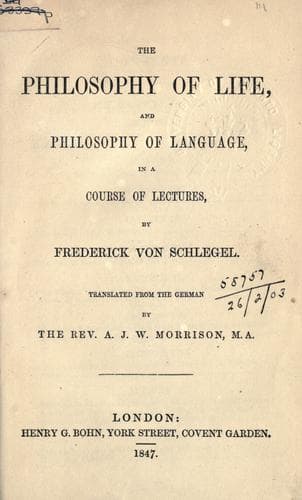
The philosophy of life, and philosophy of language, in a course of lecturesSchlegel, Friedrich von
Philosophy
The philosophy of life, and philosophy of language, in a course of lectures
Schlegel, Friedrich von
Language and languages -- Philosophy; Life; Philosophy
Another generally known and admitted species of enthusiasm, viz., a
taste for the arts, has not so universal a foundation in the
constitution of the human mind as the feeling of patriotism, but implies
a particular mental disposition, and certain natural endowments, and
consequently the sphere of its operation is far narrower. But here,
also, as in the former case, enthusiasm manifests itself as a property
or state of the soul which is far from being contented with a calm
philosophical contemplation, or admiration, of its inward thought, but
which, longing eagerly to realize and exhibit externally the idea with
which it is possessed, knows no rest nor peace till it has accomplished
its cherished object. And such an ideal enthusiasm is not confined to
the sphere of art alone, but even in the calmer regions of science is
its influence felt. It is, in short, the animating impulse of all great
inventions, creations, and discoveries. Without it Columbus would never
have been able to overcome all the dangers and obstacles which beset the
first design and the final consummation of his bold conception. But in
the latter instances the object of enthusiasm is no longer a pure ideal,
like that which animates the artist, but something great or new in the
region of useful science, or of practical life. In every case, however,
enthusiasm has for its object a something positive and real, which, even
if it be not one which captivates the soul with its transcendent beauty
and excellence, yet, at least, by its exalted nature fills it with
wonder and admiration. Quite otherwise is it with a longing--an
indefinite feeling of profound desire, which is satisfied with no
earthly object, whether real or ideal, but is ever directed to the
eternal and the divine. And although it presupposes, as the condition of
its existence, no special genius or peculiar talents, but proceeds
immediately out of the pure source of the divinely created and immortal
soul--out of the everlasting feelings of the loving soul--still, from
causes which are easily conceivable, a pure development of this species
is _far_ rarer than even of the enthusiasm for art. No doubt, in certain
happy temperaments, under circumstances favorable to their free
expansion, this vague longing is peculiar to the age of youth, and is
often enough observed there. Indeed, it is in that soft melancholy,
which is always joined with the half-unconscious, but pleasant feeling
of the blooming fullness of life, that lies the charm which the
reminiscence of the days of youth possesses for the calm and quiet
contemplations of old age. Here, too, the distinctive mark between the
genuine and the spurious manifestations of this feeling is both simple
enough, and easily found. For as this longing may in general be
explained as an inchoate state--a love yet to be developed--the question
reduces itself consequently to the simple one of determining the nature
of this love. If, upon the first development and gratification of the
Public-domain text, read in full here on John Shaqi.
Reviews
Reviews
No reviews yet
Be the first to share your thoughts on this work.
Join the Discussion
Join the discussion
Sign in to leave a comment or review.
Sign InorCreate an account