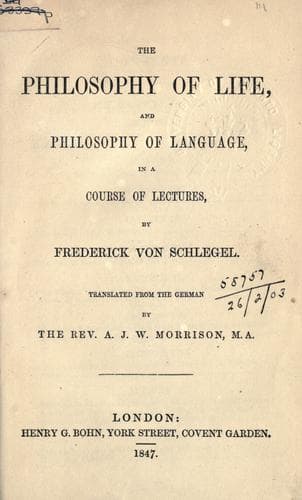
The philosophy of life, and philosophy of language, in a course of lecturesSchlegel, Friedrich von
Philosophy
The philosophy of life, and philosophy of language, in a course of lectures
Schlegel, Friedrich von
Language and languages -- Philosophy; Life; Philosophy
Congeniality of mind and temper forms, it is confessed, the sole basis
of domestic peace and contentment, and of a happy, _i.e._, of a
well-assorted marriage. But to determine on what this depends, in each
individual case, is a problem which, considering the extremely great and
infinite varieties of human dispositions, admits not of a precise or
particular solution. On this point the closest observers are not
unfrequently deceived in their predictions. How often do those agree
very well of whom previously it would not have been supposed possible?
On the contrary, those frequently live most unhappily together of whose
blissful union the judgment of society and the ordinary estimate of
human character had led to the most favorable anticipations.
Nevertheless, for the latter fact a general reason may be given. It is
not so much the similarity of tastes and pursuits, as, rather, the want
in one of some mental quality possessed by the other, that forms the
strongest source of attraction between the two sexes, so that the inner
life or consciousness of the one finds its complement in that of the
other, or, at least, receives from it a further development and
elevation. For in the same way that a certain community of goods and
property, even though not complete nor enforced by law, yet still, in
some measure and by daily use, does practically take place in
wedlock--so, also, by the constant interchange of every thought and
feeling, a sort of community of consciousness is produced, which derives
its charm and value from the very difference in the mental character of
the two sexes. When I would attempt to give a more precise determination
of this difference, I feel how difficult and incomplete must be every
attempt generally to define the varieties of mental character. And this
is especially the case when men take in hand to paint the characters of
whole ages and nations, and by contrasts endeavor distinctly to limit
and sharply to define them. Thus, for instance, the predominant element
in the mental character of the Greeks is usually said to be
intellect--comprising under this term every form and manifestation of
it, the scientific as well as the artistic, profundity not less than
acuteness, and vivid perspicuity, together with critical analysis; while
energy of will, strength of mind, and greatness of soul, are assigned to
the Romans as their distinguishing peculiarity. No doubt these
descriptions are not in general untrue. How many nicer limitations,
however, and modifications must they undergo, if we are not to rest
contented with this historical antithesis and summary--which, no doubt,
are correct enough, as far as they go--but desire, rather, to form in
idea and to set down in words a full and complete image of these two
nations in their whole intellectual life. So, too, as a general
description of the middle ages, it might be said, with tolerable truth,
that in them fancy was predominant; while in modern times reason has
Public-domain text, read in full here on John Shaqi.
Reviews
Reviews
No reviews yet
Be the first to share your thoughts on this work.
Join the Discussion
Join the discussion
Sign in to leave a comment or review.
Sign InorCreate an account