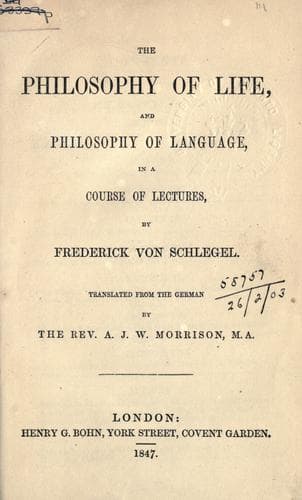
The philosophy of life, and philosophy of language, in a course of lecturesSchlegel, Friedrich von
Philosophy
The philosophy of life, and philosophy of language, in a course of lectures
Schlegel, Friedrich von
Language and languages -- Philosophy; Life; Philosophy
Moreover, the revelation by which God makes himself known to man, does
not admit of being limited exclusively to the written word. Nature
itself is a book written on both sides, both within and without, in
every line of which the finger of God is discernible. It is, as it were,
a Holy Writ in visible form and bodily shape--a song of praise on the
Creator’s omnipotence composed in living imagery. But besides Scripture
and nature--those two great witnesses to the greatness and majesty of
God--there is in the voice of conscience nothing less than a divine
revelation within man. This is the first awakening call to the two other
louder and fuller proclamations of revealed truth. And, lastly, in
universal history we have set before us a real and manifold application
and progressive development of revelation. Here the luminous threads of
a divine and higher guidance glimmer through the remarkable events of
history. For, not only in the career of whole ages and nations, but also
in the lives of individuals, the ruling and benignant hand of Providence
is every where visible.
Fourfold, consequently, is the source of revelation, from which man
derives his knowledge of the Deity, learns his will, and understands his
operation and power--conscience, nature, Holy Writ, and universal
history. The teaching of the latter is often of that earnest and awful
kind, to which we may, in a large sense, apply the adage, “Who will not
learn must feel.” How often does it show us some mighty edifice of
fortune, which, having no firm basis in the deep soil of truth and the
divine order, owed its rapid growth and false splendor to some evil
influence, falling suddenly in ruins, as if stricken by the invisible
breath of a superior power. On such occasions the public feeling
recognizes the hand which sets a limit to every temerity in the history
of the world--to every extravagance of a false confidence--and appoints
it its ultimate term. And the olden notion (which, with men of the day,
had become little more than an antiquated legend) of God’s retributive
justice, resumes its place among the actuating sentiments of life, with
new and intense significance. The sublime truth, however, is only too
soon forgotten, and the temporary alarm subsides but too quickly into
the habitual calm of a false security--that old and hereditary feeling
of human nature.
Public-domain text, read in full here on John Shaqi.
Reviews
Reviews
No reviews yet
Be the first to share your thoughts on this work.
Elsewhere in the archive
Join the Discussion
Join the discussion
Sign in to leave a comment or review.
Sign InorCreate an account