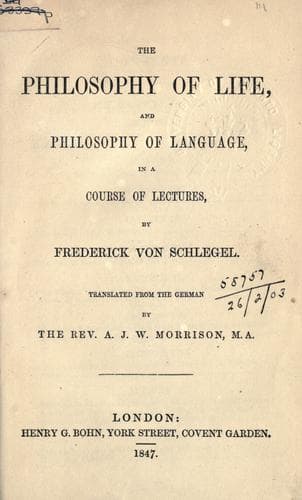
The philosophy of life, and philosophy of language, in a course of lecturesSchlegel, Friedrich von
Philosophy
The philosophy of life, and philosophy of language, in a course of lectures
Schlegel, Friedrich von
Language and languages -- Philosophy; Life; Philosophy
The volume of Holy Writ, as it is transmitted to us, and was first
commenced about three-and-thirty centuries ago, does not exclude the
possibility of an earlier sacred tradition in the twenty-four centuries
which preceded it. So far, indeed, is the supposition of such an
original revelation from being inconsistent with Scripture, that, on the
contrary, it contains explicit allusions to the fact, that such a
manifold enlightenment was imparted to the first man, as well as to that
patriarch who, after the destruction of the primeval world of giants,
was the second progenitor of mankind. But as this divine knowledge,
derived immediately from the primary source of all illumination, flowed
down in free and unconfined channels to succeeding generations, and to
the different nations which branched off from the parent stock, the
original sacred traditions were soon disfigured and overloaded with
fictions and fables. In these, however, a rich abundance of remarkable
vestiges and precious germs of divine truth were mixed up with
Bacchanalian rites and immoral mysteries. And thus, amid a multitude of
sensuous and stimulating images, the pure and simple truth was buried,
as in a second chaos, under a mass of contradictory symbols. Hence arose
that Babylonish confusion of languages, emblems, and legends, which is
universally to be met with among ancient, and even the most primitive
nations. In the great work, therefore, of purification, and of a
restoration of true religion (which we may call a second revelation, or,
at least, as a second stage thereof), a rigid exclusion of this
heathenish admixture of fable and immorality was the first and most
essential requisite. But those older revelations, imparted to the first
man and the second progenitor of mankind, are expressly laid down as the
groundwork of that evangel of the creation, which forms the introduction
to the whole volume of Scripture, and furnishes us thereby with a key to
understand the history and religion of the primitive world--or, to speak
absolutely, the true Genesis of the existing world, its history and its
science. This double principle, expressly recognizing, on the one hand,
an original revelation and divine illumination of the first progenitors
of the human race, of which the olden and less corrupted monuments of
heathenism still retain many a trace; and, on the other, strictly
rejecting the additions of a corrupt and degenerated heathenism, with
all its tissue of fables and false, godless mysteries, must be kept
steadily in view in examining the earliest portions of the sacred
Scriptures. For the neglect, or imperfect consideration of it, has
already led, and is ever likely to give rise to many complicated doubts
and perverted views, which imperil not only the simple understanding of
the whole body of revealed Scripture, but even the right conception of
revelation.
Public-domain text, read in full here on John Shaqi.
Reviews
Reviews
No reviews yet
Be the first to share your thoughts on this work.
Elsewhere in the archive
Join the Discussion
Join the discussion
Sign in to leave a comment or review.
Sign InorCreate an account