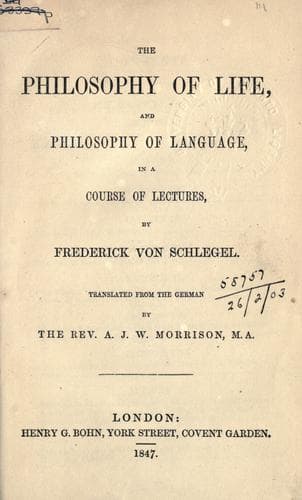
The philosophy of life, and philosophy of language, in a course of lecturesSchlegel, Friedrich von
Philosophy
The philosophy of life, and philosophy of language, in a course of lectures
Schlegel, Friedrich von
Language and languages -- Philosophy; Life; Philosophy
On this account the oldest and most natural form of philosophy was that
of dialogue, which did not, however, exclude the occasional introduction
of a simple narrative, or the continuous explanation of higher and
abstruser questions. Philosophy, accordingly, might not inappropriately
be defined as a dialogue of the soul in its free meditation on divine
things. And this was the very form it actually possessed among the
earliest and noblest of the philosophers of antiquity--first of all
really and orally, as with Pythagoras and Socrates, and lastly in its
written exposition, of which style Plato was the great and consummate
master. But it was only to the noblest and best of all ranks, though
without distinction of age or sex, that these the greatest men of
antiquity communicated their treasures of philosophical wisdom. In this
course Pythagoras first set the example, which, on the whole, was
followed also by Socrates and Plato. For, in general, the latter
confined their philosophical teaching to a select circle, and imparted
it, as it were, under the seal of friendship, to such only as in the
social intercourse of life they admitted to close and familiar intimacy.
Occasional exceptions were, perhaps, furnished by their disputes with
the sophists, in the course of which they were constrained to adopt, not
only the weapons, but also the method of their adversaries--a license of
which Plato, perhaps, has too often availed himself, even if he has not
sometimes abused it. For about this time the sophists introduced a
practice as erroneous as their doctrine was false. Publishing their
philosophemes to the whole people, they treated it and quarreled about
it in the market-place as a common party matter. Such a procedure was in
every sense pernicious, and one which must have brought even truth
itself into contempt. Lastly, Aristotle comprised in his manuals the
collective results of all earlier philosophical speculation, and
intrusted his treasury of mature knowledge and well-sifted and
newly-arranged thoughts to the keeping of a school. Now, we should be
far from justified were we to make this a reproach against this master
of subtlety and profoundest of thinkers; for at this time all true
intellectual life had, together with public spirit, become extinct among
the Greeks, amid the disorders of democracy, or under the pressure of
the armed supremacy of Macedonia. Still it must ever remain a matter of
profound regret. For philosophy, as standing in the center between the
guiding spirit of the divine education of man and the external force of
civil right and material power, ought to be true mundane soul
[_Weltseele_] which animates and directs the development of ages and of
the whole human race. Deeply, therefore, is it to be deplored whenever
science, and especially philosophy, are withdrawn from this wide sphere
of universal operation, and from human life itself, to remain banished
and cooped up in the narrow limits of a school.
LECTURE IV.
Public-domain text, read in full here on John Shaqi.
Reviews
Reviews
No reviews yet
Be the first to share your thoughts on this work.
Elsewhere in the archive
Join the Discussion
Join the discussion
Sign in to leave a comment or review.
Sign InorCreate an account