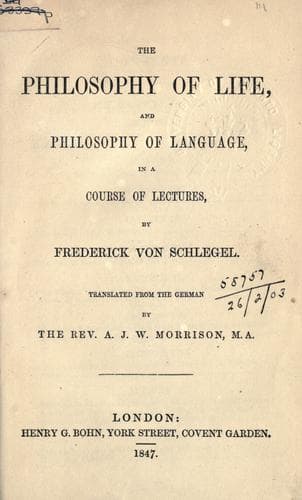
The philosophy of life, and philosophy of language, in a course of lecturesSchlegel, Friedrich von
Philosophy
The philosophy of life, and philosophy of language, in a course of lectures
Schlegel, Friedrich von
Language and languages -- Philosophy; Life; Philosophy
OF THE SOUL IN RELATION TO NATURE.
“We know in part,” exclaimed, with burning zeal, the honest man of God
in Holy Scripture, “We know in part, and we prophesy in part.” How true
the first member of this sentence is even in the case of that knowledge
of God which alone deserves the name of knowledge, or repays the trouble
of its acquisition, the previous Lecture must in many ways have served
to convince us. The second member, which will chiefly occupy our
attention in the present discussion, is in an eminent degree applicable
to physical science. For what, in fact, is all our knowledge of nature,
considered as a whole and in its inmost essence, but a mere speculation,
conjecture, and guess upon guess? What is it but an endless series of
tentative experiments, by which we are continually hoping to succeed in
unveiling the secret of life, to seize the wonderful Proteus, and to
hold him fast in the chains of science? Or is it not, perhaps, one
ever-renewed attempt to decipher more completely than hitherto the
sybilline inscriptions on the piled-up rows and layers of tombs, which
as nature grows older convert its great body into one vast catacomb, and
so perchance to find therein the key to unlock and bring to light the
far greater--nay, the greatest of all riddles--the riddle of death? Now
there are undoubtedly, even in nature itself, occasional indications of,
scattered hints and remote allusions to, a final crisis, when even in
nature and in this sensible and elementary world, life shall be entirely
separated from death, and when death itself shall be no more. Gravely to
be pondered and in nowise to be neglected are these hints, although
without the aid of a higher illumination they must forever remain
unintelligible to man. Thus considered, however, the universe itself
appears replete with dumb echoes and terrestrial resounds of divine
revelation. It is not, therefore, without reason and significance, if in
this beautiful hymn the ancient prophetess of nature lends her
concurrent testimony to the promises of the holy seer of a last day of
creation, which nature shall celebrate as the great day of her
renovation and toward which she yearns with an indescribable longing
which is nowhere so inimitably depicted, so strongly and so vividly
expressed, as in Holy Writ itself. Holy Scripture could not and can not
contain a system of science, whether as a philosophy of reason or a
science of nature. Nay, in this form of a manual and methodical
compendium of divine knowledge, it could not inspire us with confidence
either as revelation or as science. Condescending altogether to the
wants of man, both in form and language, it consists of a collection of
occasional and wholly practical compositions derived immediately from,
and expressly designed for, life--in a certain sense it consists of
nothing but the registers and social statutes either of the prophetic
people or of the apostolical community. Accordingly, its contents are of
Public-domain text, read in full here on John Shaqi.
Reviews
Reviews
No reviews yet
Be the first to share your thoughts on this work.
Elsewhere in the archive
Join the Discussion
Join the discussion
Sign in to leave a comment or review.
Sign InorCreate an account