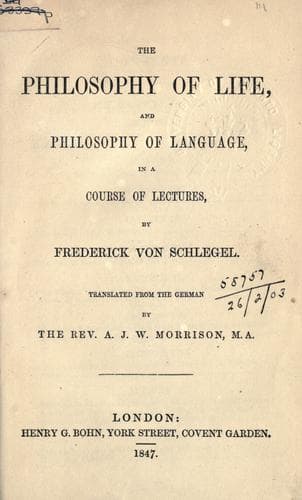
The philosophy of life, and philosophy of language, in a course of lecturesSchlegel, Friedrich von
Philosophy
The philosophy of life, and philosophy of language, in a course of lectures
Schlegel, Friedrich von
Language and languages -- Philosophy; Life; Philosophy
a mixed nature: historical, legal, instructive, hortatory, consolatory,
and prophetical, together with a rich abundance of minute and special
allusions, while it enters every where into, and with watchful love
adapts itself to, individual wants and local peculiarities. And the form
of these writings, at once so singular in its kind--and in such
marvelous wise, but yet so eminently human--is so far from being
inconsistent with the divine character, that the very condescension of
the Deity constitutes a new and additional but most characteristic proof
of genuine revelation. Only the first foundation-stone and the key and
corner-stone form an exception. Embracing within their spacious limits
the beginning of nature and the end of the world, they form, as it were,
the corner-rings and the bearing-staves of the ark of the covenant of
revelation. And while on the one side as well as on the other, in the
opening no less than in the closing book, which contain almost as many
mysteries as words, the seven-branched candlestick of secret
signification is set up, still all else that is inclosed within the holy
ark receives therefrom sufficient light for its perfect elucidation. In
all other respects the style is that of a plain narrative couched in
very appropriate and simple words; and if the masters of criticism in
classical antiquity have quoted a few passages from the beginning of
Genesis as the most exalted instances of the sublime, still it was in
the very simplicity and extreme plainness of the language that they
recognized this character of sublimity. From these two ends,
moreover--from this first root as well as from the last crown of the
book, there proceeds many threads and veins, which, running through the
tissue, bind it together more closely into a living unity, on which
account, although consisting of so many and such divers books, it is
justly considered as one, being called simply the “Book” (Bible).
Consequently it would, as already said, be foolish to look for a system
of science in the divine book for men. Nevertheless we do meet here and
there with single words about nature and her secrets--hints occasionally
dropped and seemingly accidental expressions--which, giving a clear and
full information as to much that is hidden therein, furnish science
consequently with so many keys for unlocking nature. These, indeed, are
not scattered throughout in equal measure, but here, perhaps, more
thinly, and there again more thickly. In all these passages, and
especially those of the Old Testament, which not only depict the
external beauties and visible glory of nature, but also touch upon its
hidden powers and inmost secrets of life, we may observe a kind of
intentional, I might, perhaps, say, cautious reserve and heedful
circumspection, amounting at times almost to an indisposition to speak
out fully and clearly, lest the abuse or probable misconception of what
should be said might give encouragement to the heathenish and
Public-domain text, read in full here on John Shaqi.
Reviews
Reviews
No reviews yet
Be the first to share your thoughts on this work.
Elsewhere in the archive
Join the Discussion
Join the discussion
Sign in to leave a comment or review.
Sign InorCreate an account