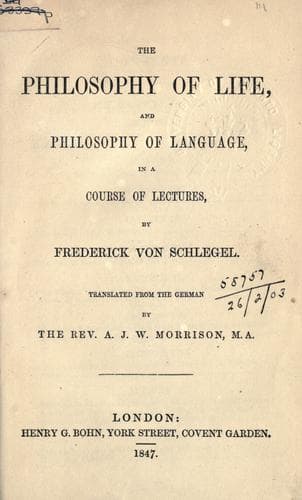
The philosophy of life, and philosophy of language, in a course of lecturesSchlegel, Friedrich von
Philosophy
The philosophy of life, and philosophy of language, in a course of lectures
Schlegel, Friedrich von
Language and languages -- Philosophy; Life; Philosophy
I have already more than once called your attention to the method which
all the philosophers of reason, without exception, pursue. In different
ways, according to the special objects they have in view, they all alike
presumed to set certain absolute and impassable limits to human reason
(which, however, by some slight turn or other, they soon dextrously
contrive to transgress) in order to bring within their system of
absolute science--which is at best but a dead semblance--all that it
will hold, and even what it can not contain. Quite different, however,
is it with the truth, and with that living science which we take for the
basis of our speculations. For from it it appears that the soul of man,
however liable it may be to manifold error, is, nevertheless, capable of
receiving the divine communications. Since, then, man can possess as
many of these higher branches of knowledge, and can learn as much of
divine things as it is given to him to know, and since, at the same
time, it is God himself who is the primary source from which all man’s
knowledge flows, and his guide to truth--who shall determine the measure
and fix the limits--who shall dare to say how much of knowledge and of
science God will vouchsafe to man?--who shall venture to prescribe the
limits beyond which His illumination can not pass? This, it is evident,
is illimitable. It may go on to an extent which, at the beginning, man
would not have believed to be possible. In a word, though of himself,
and by his own unassisted reason, man is incapable of knowing any thing,
yet through God, if it be his will, he may attain to the knowledge of
all things. And yet it is true, though in a very different sense from
that intended by these philosophers of reason, that man’s knowledge is
in reality limited. No absolute limit, indeed, is set to it. Yet because
it is a mixed knowledge, composed of outward tradition and inward
experience, and is founded on the perceptions of the external and
internal senses, therefore is it made up of individual instances,
extremely slow in its growth, and in no respect perfect and complete,
and scarcely ever free from faults and deficiencies. Consequently, when
considered in its totality, and as pretending to be a whole, it is
invariably imperfect. But this character of imperfection belongs, in
fact, to all real science, as derived from the experience of the senses.
Seldom, indeed, is the first impression free from the admixture of
error; numberless repeated observations, comparisons, essays,
experiments, and corrections, which must often be carried on through
many centuries, not to say many tens of centuries, are necessary before
a pure and stable result can be attained to. In this way all truly human
knowledge is imperfect, and “in part;” and although, on the contrary,
the false conceited wisdom may parade itself from the very first as
fully ripe and complete, yet in a very brief space indeed will its
imperfection and rottenness appear.
Public-domain text, read in full here on John Shaqi.
Reviews
Reviews
No reviews yet
Be the first to share your thoughts on this work.
Elsewhere in the archive
Join the Discussion
Join the discussion
Sign in to leave a comment or review.
Sign InorCreate an account