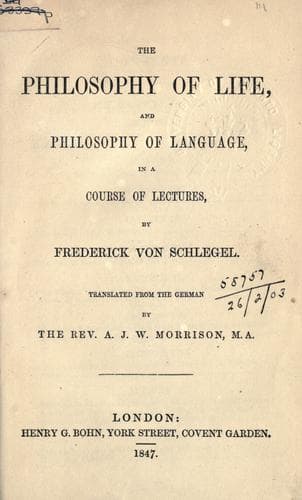
The philosophy of life, and philosophy of language, in a course of lecturesSchlegel, Friedrich von
Philosophy
The philosophy of life, and philosophy of language, in a course of lectures
Schlegel, Friedrich von
Language and languages -- Philosophy; Life; Philosophy
And, indeed, the character of imperfection shows itself, as in all other
human things, so also in the science of nature. From its birth among the
earliest naturalists of Greece to its boasted maturity among ourselves,
it counts an age of two millenniums and a half of unbroken cultivation.
But now if, looking beyond the explanation of single isolated facts, we
consider rather our knowledge of nature in its universal system and
internal constitution, can we say that physical science has, during the
time, made more than, perhaps, two steps and a half of progress? And
this slow and toilsome advance which, in a certain sense, never arrives
at more than “knowing in part,” is the law of every department of human
science. Consequently it may be justly said of the development of man’s
science, that with God a thousand years are as a day, and one day as a
thousand years.[21] All knowledge drawn from the senses and experience
is bound by this condition. It may, no doubt, apply immediately and
principally to external experience, which is dependent on the lower and
ordinary senses, whether we reckon them according to the number of their
separate organs as five, or as three in compliance with a more
scientific classification. But it also holds equally good of those which
we pointed out and described in the last Lecture as being the four
superior scientific senses, the organs of a knowledge founded on a
higher and internal experience, the sense, viz., of reason, the sense of
understanding, the sense for nature or fancy, and the proper sense for
God, which lies in the inmost free will of man. Not merely as the
faculty of suggestion [_Ahndungsvermogen_], is fancy to be regarded as
the higher and internal sense for nature, or because it is from this
side that the affinity of man, and of man’s soul with nature, is most
distinctly revealed, but it also exhibits itself as such in the
scientific apprehension of natural phenomena. That dynamical play of the
inner life, that law of a living force which constitutes the essence of
every phenomenon of nature, is a something so fleeting and evanescent
that it can only be seized and fixed by the fancy alone, since, as is
now pretty generally allowed by all profound observers of nature, in the
abstract notion life eludes the grasp, and nothing remains but a dead
formula.
Public-domain text, read in full here on John Shaqi.
Reviews
Reviews
No reviews yet
Be the first to share your thoughts on this work.
Elsewhere in the archive
Join the Discussion
Join the discussion
Sign in to leave a comment or review.
Sign InorCreate an account