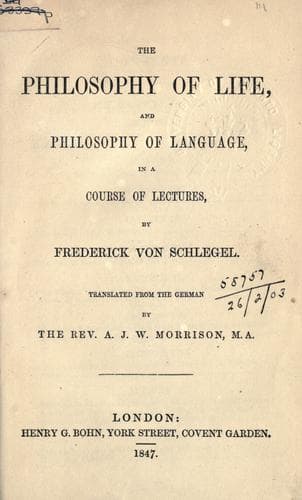
The philosophy of life, and philosophy of language, in a course of lecturesSchlegel, Friedrich von
Philosophy
The philosophy of life, and philosophy of language, in a course of lectures
Schlegel, Friedrich von
Language and languages -- Philosophy; Life; Philosophy
The question of innate ideas has been often mooted in philosophy. As,
however, the essential functions and different acts of thought, together
with its several notions, are, properly speaking, nothing but the
natural division of man’s cogitative faculty, it is not on their account
necessary to suppose such a preliminary intercalation of general ideas
into the human mind. And as little necessary is it, in order to explain
the universal belief in the existence of a Deity, to suppose that there
is in the minds of all men an implanted idea of God; for this would lead
to the purely arbitrary hypothesis, of that which is so difficult to
conceive--the pre-existence of the spirit or soul of man. And as no
created beings can have an idea of God, but those to whom He vouchsafes
to communicate it, and to accord a knowledge of His existence, so can He
bestow this privilege the very instant He pleases, without the
intervention of any innate idea expressly for that end. And yet I am
disposed, and not, I think, without reason, to assume that man, as at
present constituted, does possess one, though only one, species of
inborn ideas, viz., an innate idea of death. This, as a false root of
life, and a true mental contagion, produces a dead cogitation, and is
the origin of all dead and dead-born notions. For this idea of death,
whether hereditary or inoculated in the soul, is, as its peculiar but
fundamental error, transferred by the mind of man to every object with
which it comes in contact. And thus, in man’s dead cogitation, the
surrounding world and all nature appears to him a similar lifeless and
inert mass, so long as sitting beneath this shadow of spiritual death,
his mind [_geist_] has not sufficient strength to work its way out of
its dark prison-house into the light. For not at all without higher aid,
and even with it only slowly and tardily, does man discover that all
that is really and naturally dead is within himself, or learn to
recognize it for what it truly is, a something eminently null and
naught. Another species of this false and dead conception of nature
presents itself under the form of multiplicity. In this view nature is
represented as forming something like a vast sandhill, where, apart from
the pile they thus form together and their aggregation in it, the
several grains are supposed to have no connection with each other;
while, however, they are so diligently counted, as if every thing
depended on their right enumeration. But through the sieve of such an
atomistic, which would break up the universe into a number of separate
and absolute individualities, the sand will ever run, however often and
painfully man may strive to reckon or to measure the infinity of these
grains of nature. Mathematical calculation and measuring hold the same
place in physical science that is held in every living language by
conjugating and declining, and other grammatical rules, which, in truth,
are but a species of mathematical formulæ.
Public-domain text, read in full here on John Shaqi.
Reviews
Reviews
No reviews yet
Be the first to share your thoughts on this work.
Elsewhere in the archive
Join the Discussion
Join the discussion
Sign in to leave a comment or review.
Sign InorCreate an account