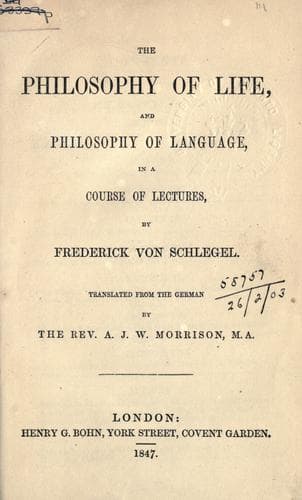
The philosophy of life, and philosophy of language, in a course of lecturesSchlegel, Friedrich von
Philosophy
The philosophy of life, and philosophy of language, in a course of lectures
Schlegel, Friedrich von
Language and languages -- Philosophy; Life; Philosophy
In learning a foreign and
especially a dead language, these are indispensable and necessary aids,
which greatly promote and facilitate its acquisition; so also
mathematics furnish indispensable helps and a most valuable organon for
the cognition of nature. But with them alone man will never learn to
understand even a word, not to talk of a whole proposition, out of
nature’s strangely-sounding and most difficult hieroglyphics.
Somewhat different is it, when man seeks to understand the true living
geometry in nature herself, _i.e._, attempts to discover the place which
the circle and eclipse (passing from these up to the spheres in their
sidereal orbits), or which the triangle, the square, the hexagon, and so
forth, assume in the scale of its creations--or when, in a similar
spirit, he investigates and ascertains the really dominant rule in the
arithmetic of life; those numbers which the physician observes in the
periodic developments of life, and which, in the fluctuating states of
an abating and heightening malady, enable him, under certain conditions,
to predict the moment of its crisis. Of a still higher kind is that
spiritual, we might almost call it divine chronology, which, in
universal history, marks out definite epochs of the mental development
of the human race, and traces therein the influence of certain grades of
life, or ages of the world, and the alternating phases of disease in
whole communities, and those decisive moments and great critical
emergencies in which God Himself appears as the healing Physician and
Restorer of life. It was, in all probability, in reference to such an
arithmetic, or in some similar sense, that Pythagoras taught that
numbers are, or contain the essence of things. For such an arithmetic of
life and geometry of nature do afford a positive cognition and a real
knowledge. As commonly understood, however, mathematics are nothing more
than a formal science--in other words, they are simply a scientific
organon, rather than a science. But now, if nature be not regarded as
dead, but living, who can doubt that it--or, as we are now speaking of
man’s nearest neighbor--that the earth is akin to man? Was he not formed
out of the dust of the earth, and is he not therefore the son, nay, in
truth, the first-born of the earth?--does he not receive from it food
and nourishment? and when the irrevocable summons goes forth from above,
does he not give back again to its bosom the earthly tabernacle of his
flesh? Do not chemists tell us that the principal constituent of the
purest wheat-corn has a great affinity to the substance of man’s blood?
and does not the blood, moreover, derive one of its ingredients from
iron--the principal among the metals of the earth? And are not gold and
other metallic substances either wholesome medicines or deadly poisons?
And is there not also an inexhaustible store of both in the wonderful
varieties of herbs and plants? Do not invigorating and healing springs
Public-domain text, read in full here on John Shaqi.
Reviews
Reviews
No reviews yet
Be the first to share your thoughts on this work.
Elsewhere in the archive
Join the Discussion
Join the discussion
Sign in to leave a comment or review.
Sign InorCreate an account