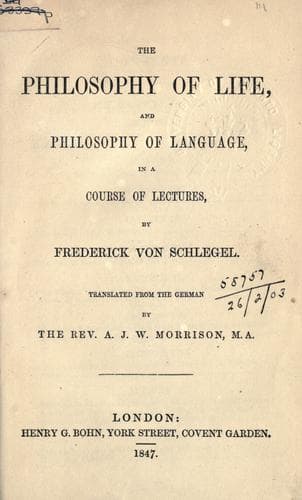
The philosophy of life, and philosophy of language, in a course of lecturesSchlegel, Friedrich von
Philosophy
The philosophy of life, and philosophy of language, in a course of lectures
Schlegel, Friedrich von
Language and languages -- Philosophy; Life; Philosophy
burst from numberless rocks and fissures of the earth? Is not--to speak
only of the heavenly bodies nearest to and immediately connected with
our globe--is not the sun’s heat so specifically different from every
other kind of warmth, the quickener of all that lives and moves, and for
man under a milder clime, as it were, a soft renovating bath? And is not
the other and lesser light--earth’s mighty satellite and companion, the
moon--the cause of all those changes in the weather and atmosphere,
which, from the earliest times, have been acknowledged to be most
serviceable and highly beneficial to agriculture? Is not the great pulse
of the ocean, in its ebb and flow, measured by it, as well as many
periods, of the development of life? And is it not, when its operation
is too powerful or violently exciting, the cause of a peculiar disease
among men? As, therefore, the musical unisons in the melodious songs of
birds, both find and wake a concordant echo in the heart of man, so,
too, in a larger scale, the blood-soul of man, with its living pulsation
and organic sensibility, is most nearly akin to and sympathizes with the
earth and the whole earthly frame. And is not, in all probability, this
sympathetic influence between the earth and man reciprocal? Must not,
for instance, the respiration of nine hundred millions of human beings
have affected the atmosphere? Has not the very air degenerated with the
human race, and like it become corrupt and deteriorated? Are not certain
pestilential diseases propagated by the air alone, being carried in
fixed telluric directions, without material contact or pollution? And
if, in answer to the inference which we would draw from these facts, any
one should sit down to calculate the number of cubic miles in the
atmospheric belt, and argue that the breath and evaporation from ever so
many myriads of human beings would be insufficient to have any effect
thereon, we might easily retort upon him the equally vast reckoning of
the millions of seconds which make up a hundred and more generations,
and by which these respirations must be counted. But, however this may
be, it does appear that the air must, in primitive times, have been far
more pure and balsamic, and more vital and more nutritive, than at
present. For before the Flood men required neither flesh nor wine to
recruit their strength, and yet, in duration of life and bodily vigor,
and above all in energy of will and powers of mind, they far surpassed
the sons of a later age; and it was even by the misuse of these great
gifts and endowments that they brought down the divine vengeance on
their sinful generation. And, lastly, if the earth were wholly without
life, how could it, at the creation of the animals of this planetary
world, have yielded obedience to the behest of the Creator, as it went
forth on the sixth day, “Let the earth bring forth the living creature
after its kind?” Highly important, moreover, as regards the true
Public-domain text, read in full here on John Shaqi.
Reviews
Reviews
No reviews yet
Be the first to share your thoughts on this work.
Elsewhere in the archive
Join the Discussion
Join the discussion
Sign in to leave a comment or review.
Sign InorCreate an account