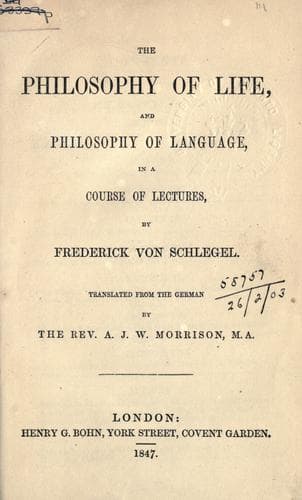
The philosophy of life, and philosophy of language, in a course of lecturesSchlegel, Friedrich von
Philosophy
The philosophy of life, and philosophy of language, in a course of lectures
Schlegel, Friedrich von
Language and languages -- Philosophy; Life; Philosophy
Thus did the mind of man advance the first step toward the maturity of
physical science, by attaining to a more comprehensive survey of the
mundane system, and a more accurate knowledge of his own habitation, of
this earthly planet. The next step in this sluggish progress was made by
the chemical discoveries of modern times, and especially of the French
chemists. In a merely negative point of view, these have been important,
as establishing the fact that the old elements, water, for instance, and
air, which had long been regarded as simple, are themselves decomposable
into other constituents and aeriform parts. And, indeed, that such great
powers of nature as these are, and must ever remain so long as the
present constitution of the world shall last, could only subsist in the
reciprocal dynamical relation of several conflicting forces, a
profounder glance at nature would of itself have conjectured and
presupposed. But in a positive sense, this second step has carried us
very far toward the understanding of the hieroglyphics of nature. Those
primary elements of things discovered and numbered by that chemical
analysis which has subjected to its experiments almost every form and
species of matter, constitute, as it were, the permanent material
letters and consonants of the natural world around us. On the other
hand, the vowels of human language are represented by the fundamental
facts of the magnetism of the earth, together with the phenomena of
electricity, the decomposition of light, and the chemical chain of the
galvanic pile, in which the inner life of the terrestrial force, and of
the eternally-moving atmosphere, as well as the soul whose pulse beats
therein, finds an utterance, like a voice out of the lowest deep. And
thus, by means of an alphabet of nature, which, however, is still most
imperfect, we may hope to make a beginning, at least, and to decipher
one or two entire words. But modern chemistry has made a more important
advance toward a right understanding of nature as a whole. By analyzing
and decomposing all solid bodies, as well as water itself, into
different forms of a gaseous element, it has thereby destroyed forever
that appearance of rigidity and petrifaction which the corporeal mass of
visible and external nature presents to our observation. Every where we
now meet with living elemental forces, hidden and shut up beneath this
rigid exterior. The proportion of aqueous particles in the air is so
great, that, if suddenly condensed, they would suffice for more than one
flood. And a similar deluge of light would ensue, if all the luminous
sparks which are latent in the darkness were simultaneously set free;
and the whole globe itself would end in flame, were all the fiery
elements that are at present dispersed throughout the world to be at
once disengaged and kindled. The investigation of the salutary bonds
which hold together these elementary forces in due equilibrium,
Public-domain text, read in full here on John Shaqi.
Reviews
Reviews
No reviews yet
Be the first to share your thoughts on this work.
Elsewhere in the archive
Join the Discussion
Join the discussion
Sign in to leave a comment or review.
Sign InorCreate an account