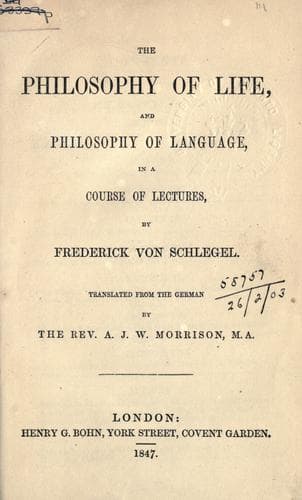
The philosophy of life, and philosophy of language, in a course of lecturesSchlegel, Friedrich von
Philosophy
The philosophy of life, and philosophy of language, in a course of lectures
Schlegel, Friedrich von
Language and languages -- Philosophy; Life; Philosophy
controlling one by the other, and confining each within its prescribed
limits, does not fall within the scope of our present inquiries, as
neither does the question, whether these bonds be not of a higher kind
than naturalists commonly suppose? More immediately connected with, as
also more important for our general subject, is the result which
chemical analysis has so indubitably established, that in the natural
world every object consists of living forces, and that properly nothing
is rigid and dead, but all replete with hidden life. This colossal
mountain range of petrified mummies which forms nature on the
whole--this pyramid of graves, piled one over the other, is therefore,
it is true, a historical monument of the past--of all the bygone ages
of the world in the advancing development of death; but nevertheless,
there is therein a latent vitality. Beneath the vast tombstone of the
visible world there slumbers a soul, not wholly alien, but more than
half akin to our own. This planetary and sensible world, and the
earth-soul imprisoned therein, is only apparently dead. Nature does but
sleep, and will, perhaps, ere long awake again. Sleep generally is, if
not the essence, yet, at least, an essential signature and
characteristic of nature. Every natural object partakes of it more or
less. Not the animals only, but the very plants sleep; while in the
vicissitudes of the seasons, and of their influences on the productive
surface of the earth, and, in truth, on the whole planet, a perpetual
alternation is perceptible between an awakening of life and a state of
slumbering repose. Whatever, consequently, partakes, and requires the
refreshment of sleep, belongs, even on that account, to nature.
Painters, indeed, have given us pictures of sleeping angels or genii;
but the pure spirits sleep not, and stand, in truth, in no need of such
rest, and their activity is not subject to this necessity of alternate
repose.
Public-domain text, read in full here on John Shaqi.
Reviews
Reviews
No reviews yet
Be the first to share your thoughts on this work.
Elsewhere in the archive
Join the Discussion
Join the discussion
Sign in to leave a comment or review.
Sign InorCreate an account