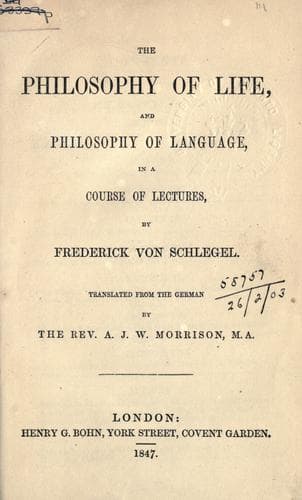
The philosophy of life, and philosophy of language, in a course of lecturesSchlegel, Friedrich von
Philosophy
The philosophy of life, and philosophy of language, in a course of lectures
Schlegel, Friedrich von
Language and languages -- Philosophy; Life; Philosophy
The comparison of a sentence in the Mosaic history of the creation, with
a passage in the Hindoo cosmogony, somewhat similar in kind, but most
different in the application, will serve, perhaps, to place this fact in
the clearest light. In the former it is said, “God rested on the seventh
day.” Now, in this expression there is nothing to startle us. In
explaining it, there is no need to have recourse to a figurative
interpretation. It does not allude to God’s inmost nature (which admits
not of such alternation of states or need of rest), but simply to His
external operations. For in every case where an operation of the Deity
takes place, whether in history or nature, an alternation between the
first divine impulse, and a subsequent period of repose, is not only
conceivable but actually noticeable. For the divine impulse or hand is,
as it were, withdrawn, in order that this first impulse of the Creator
may fully expand itself, and that the creature adopting it, may carry it
out and develop his own energies in accordance therewith. But instead of
this correct statement, we have, in the Hindoo cosmogony, that “Brahma
sleeps.” While he thus slumbers, the whole creation, with its worlds and
mundane developments, is said to collapse into naught. Here, then, a
single word hurries us from the sure ground of truth and divine
revelation into the shifting domain of mythology. Of Him indeed, who is
higher than the angels and created spirits, it is no doubt assumed
throughout the New Testament that, while on earth, He slept like other
men. Once, too, it is expressly stated, that during a great storm, while
His disciples were filled with alarm, He was asleep in the hinder part
of the ship; but that when He awoke the winds ceased. But here, also,
the case is different. While implying many a great object and
instructive lesson besides, this passage, like several others, seems
designed to prove that our Lord’s body was no mere phantom; but that He
took upon Him a real human form, and was, in truth, a man who stood in
need of sleep. And from this we may infer, that sleep is so
indispensable a condition of natural existence, that even God Himself,
as soon as He condescended to enter its limits by taking upon Him a
human body, became subject to nature’s essential law of sleep.
Public-domain text, read in full here on John Shaqi.
Reviews
Reviews
No reviews yet
Be the first to share your thoughts on this work.
Elsewhere in the archive
Join the Discussion
Join the discussion
Sign in to leave a comment or review.
Sign InorCreate an account