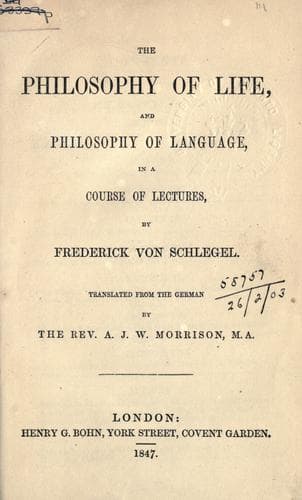
The philosophy of life, and philosophy of language, in a course of lecturesSchlegel, Friedrich von
Philosophy
The philosophy of life, and philosophy of language, in a course of lectures
Schlegel, Friedrich von
Language and languages -- Philosophy; Life; Philosophy
lie in the simple sentence--“Death came into the world by sin.” As,
then, by the death of the first man, who was not created for, nor
originally designed for death, death has passed upon the whole human
race; so by the earlier fall of him, who had been the first and most
glorious of created spirits, death passed upon the universe--that
eternal death whose fire is unquenchable. Hence it is written: “Darkness
was on the face of the deep, and the earth”--as the mere grave of that
eternal death--“was without form and void;” but the “spirit of God moved
on the face of the waters,” and therein lay the first germ of life for
the new creation. We here see the difference between all heathen systems
of natural philosophy and a divine knowledge of nature, _i.e._, one
acquired in and by God, and also the key for a right understanding of
the latter.
If now the dynamic play of the living forces of nature, which is
unquestionably a living entity, and has a life in itself though not
indeed of and from itself--if this dynamical alternation between life
and death be regarded as a simple fact, and man is content to rest
there, without seeking to explain it by a higher principle, then will he
have ever the self-same One--an all-producing, all-absorbing, ruminating
monster, whether we express it poetically, as in mythology, or in the
scientific formularies of physiology. Quite different is it, however, if
this great pyramid has been built upon the foundation of eternal death.
Then is the whole creature of this earthly planet and sensible world
merely a commencing life which, so long as the pyramid is still
unfinished and incomplete, is, in parts, perpetually relapsing into
death--into actual death, or at least into diseases and fractures of
various kinds, which are only so many _principia_ or germs of death.
Then is nature itself nothing less than the ladder of resurrection,
which, step by step, leads upward, or, rather, is carried from the abyss
of eternal death up to the apex of light in the heavenly illumination.
For, understanding it in this sense, it is impossible to think of nature
without remembering at the same time the divine hand which has built
this pyramid, and which, along this ladder, brings life out of death.
This view, moreover, accounts for the fact, that a state of slumber is
essential to nature, and furnishes an explanation why that
perpetually-recurring collapse into sleep, which to us appears so near
akin to death, should be nature’s proper character. And just as the
consuming fire of death appears in the more highly-organized beings to
be somewhat subdued and restrained--mitigated or exalted into the
quickening warmth of life--so also sleep is only the more than
half-enlightened brother of death. And indeed as such, and the lovely
messenger of hope to immortal spirits, was he ever regarded and
described by the ancients; but that which for them was little more than
a beautiful image of poetry is for us the profoundest of truths.
Public-domain text, read in full here on John Shaqi.
Reviews
Reviews
No reviews yet
Be the first to share your thoughts on this work.
Elsewhere in the archive
Join the Discussion
Join the discussion
Sign in to leave a comment or review.
Sign InorCreate an account