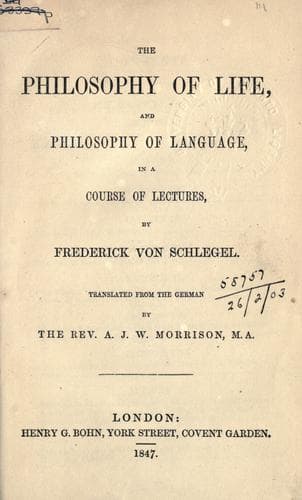
The philosophy of life, and philosophy of language, in a course of lecturesSchlegel, Friedrich von
Philosophy
The philosophy of life, and philosophy of language, in a course of lectures
Schlegel, Friedrich von
Language and languages -- Philosophy; Life; Philosophy
An exalted view and understanding of nature consists, then, in its being
contemplated not merely as a dynamical play of reciprocal forces, but
historically in its course of development, as a commencing life,
perpetually relapsing into death, ever disposed to sleep, and only
painfully raising itself, or, rather, raised and lovingly guided through
all the intermediate grades into the light. But beneath the huge
tombstone of outward nature there sleeps a soul, not wholly alien, but
half akin to ourselves--which is distracted between the troubled and
painful reminiscence of eternal death, out of which it issued, and the
flowers of light which are scattered here and there on this dark earth,
as so many lovely suggesters of a heavenly hope. For this earthly
nature, as Holy Writ testifies,[24] is, indeed, subject to nullity, yet,
without its will, and without its fault: and consequently in hope of Him
who has so subjected it, it looks forward in the expectation that it
shall one day be free, and have a part in the general resurrection and
consummate revelation of God’s glory, before which both nature and death
shall stand amazed--and for this last day of a new creation it sighs
anxiously, and yearns with the profoundest longing.
LECTURE V.
OF THE SOUL OF MAN IN RELATION TO GOD.
A divine science of nature--one, _i.e._, which is ever looking to and
has its root in God, unlike the old heathen physiologies--sees something
more in nature than a mere endless play of living forces and the
alternations of dynamical action. Contemplating it rather as a whole,
and in the connection of its several parts, it traces it from the first
foundation on which it was originally raised, up to the final
consummation which the Almighty has designed it to attain. Now, to such
a mode of studying it, nature appears to be in its beginning, as it
were, a bridge thrown across the abyss of eternal death and eternal
nothingness. And in perfect agreement with this origin or foundation, it
exhibits itself at the outset as a house of corruption, a character
which, to a certain degree, it subsequently and long afterward retains.
After a while, however, this house of corruption is transformed, by the
omnipotence of the good Creator, into a laboratory of new life, and
finally is raised into a ladder of resurrection, ascending, or, rather,
is made to conduct, step by step, to the highest pitch of earthly
glorification, in which nature, too, has a promise that she shall
partake. This was the subject of the preceding Lecture, and it naturally
enough suggests the further question, whether a similar scale of gradual
exaltation exists for the human soul, which, even while it is in many
respects akin to mother earth and to nature generally, is, nevertheless,
far more excellent, and, by its innate dignity, claims to be regarded as
the very head and crown of this earthly creation. The inquiry then,
whether the soul of man, gradually rising out of the depths of this
Public-domain text, read in full here on John Shaqi.
Reviews
Reviews
No reviews yet
Be the first to share your thoughts on this work.
Elsewhere in the archive
Join the Discussion
Join the discussion
Sign in to leave a comment or review.
Sign InorCreate an account