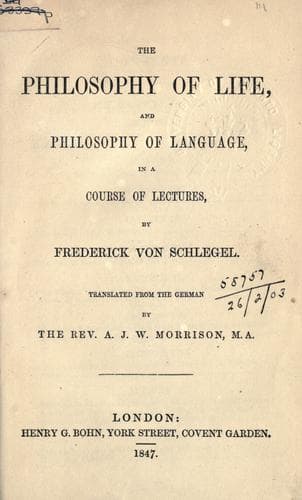
The philosophy of life, and philosophy of language, in a course of lecturesSchlegel, Friedrich von
Philosophy
The philosophy of life, and philosophy of language, in a course of lectures
Schlegel, Friedrich von
Language and languages -- Philosophy; Life; Philosophy
perishable existence and the bondage of corruption, up to God, can
approach nearer to, and finally be totally identified with Him; or at
least, whether it is capable of being united in a perfect and lasting
harmony with the superior powers of a higher and a diviner region--this
will form the theme of our present disquisition. In discussing it,
however, our attention will be directed principally to its psychological
aspect--its relation, _i.e._, to the theory of consciousness. For the
moral examination of this subject, even if it be not allowable to assume
that it, at all events, is well known, belongs to another department of
inquiry.
Now, on this head, the following remark immediately and naturally
suggests itself to the reflecting mind. Unless the soul be at unity with
itself it can not hope ever to be one with, or to attain to an harmonic
relation with that Being, who, as he is the one source and principle of
all and on whom all depends, is in himself a pure harmony. But so far is
this condition from being fulfilled in the actual state of the human
consciousness, that the latter appears rather to consist of pure and
endless discord. Fourfold, I said, is man’s consciousness; and I called
its four conflicting forces, viz., understanding and will, reason and
fancy, its four poles, or chief branches, or even the four quarters of
the internal world of thought. How seldom, however, do the understanding
and will agree together. Does not each of them prefer to follow an
independent course of its own? How seldom do men really and
perseveringly will and desire what they clearly see and acknowledge and
perfectly understand to be the best! And how often, on the other hand,
do we understand little or nothing of that, which yet in the inmost
recesses of our hearts, we most desire and wish, and most ardently and
determinedly resolve upon! Reason and fancy, too, both in the inner
thought and in outward life also, are, on the whole, in hostile conflict
with each other. Reason would wish to suppress or at least to dispense
altogether with fancy, while fancy, caring, for the most part, but
little or nothing for the reason, goes its own way. The will, moreover,
unceasingly distracted, is never even at peace with itself, while the
reason, standing alone in the endless evolution of its own thought,
entangles itself at last in a labyrinth of irreconcilable
contradictions. The understanding, again, has so many grades and
species, and divides itself among so many spheres and functions, that in
this respect we might be justified in saying: This one understanding
understands not the other, even though it be equally correct both in
itself and in its mode of operation. And thus, too, in the individual:
his understanding, the sum, _i.e._, of all that he understands,
consists, for the most part, but of rags and fragments of truth, which
often enough do not match very well, and seldom, if ever, admit of being
made to blend harmoniously together.
Public-domain text, read in full here on John Shaqi.
Reviews
Reviews
No reviews yet
Be the first to share your thoughts on this work.
Elsewhere in the archive
Join the Discussion
Join the discussion
Sign in to leave a comment or review.
Sign InorCreate an account